
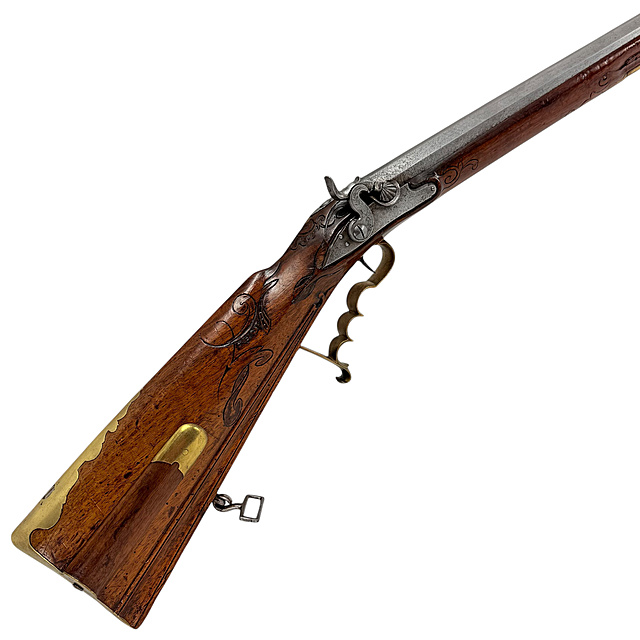
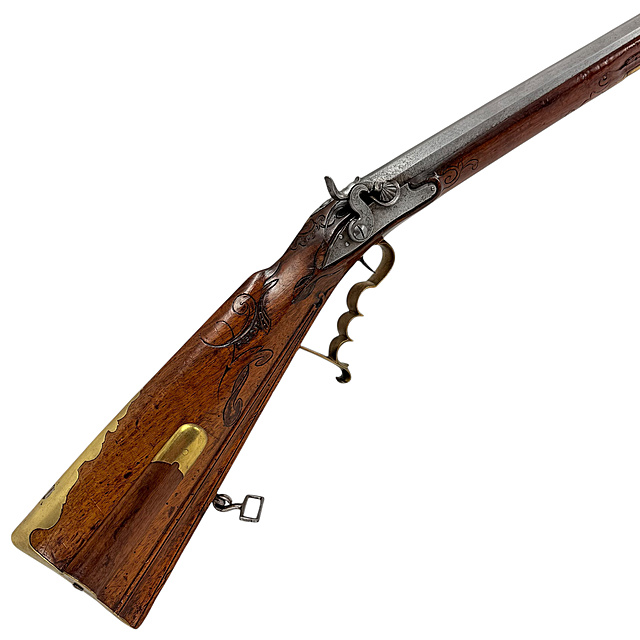
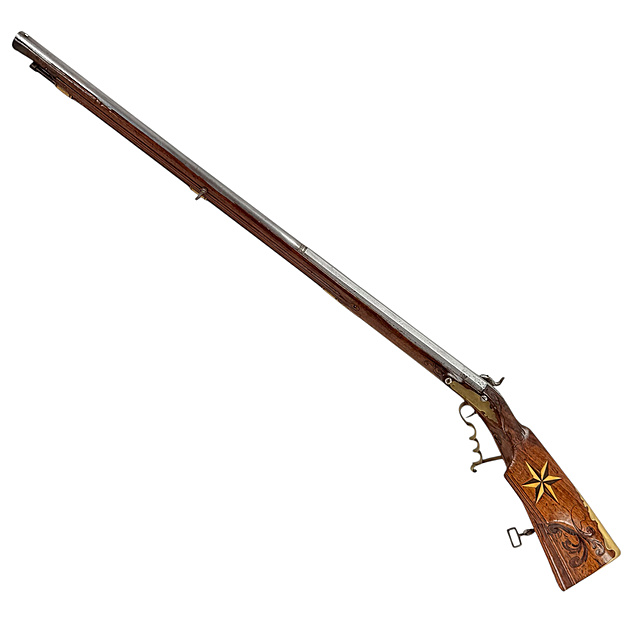
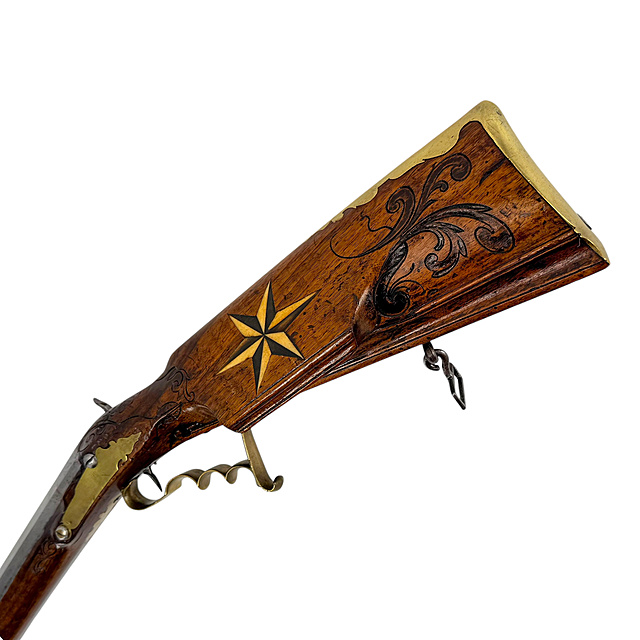
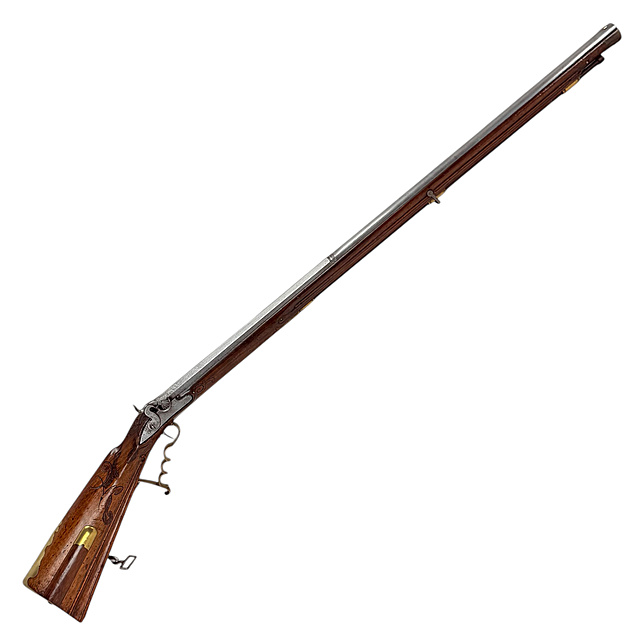
Baroque hunting gun, carved stock with star inlay, converted to percussion, circa 1740
Hunting gun in calibre 15 mm with smoothbore barrel, octagonal at the breech and round after a transition ring, without signature or marks, brass front sight at the muzzle. Flintlock converted to percussion: flat lock plate of flintlock form with pointed tail, S-shaped curved hammer, lock plate and hammer with foliate scroll engraving. Baroque carved walnut full stock with rocailles and foliate scrolls, German cheek-piece butt, on the cheek a large six-pointed star inlay, the rays inlaid in two colours in bone and horn; on the right side of the butt a patchbox with wooden sliding cover and brass cap. Brass mounts: butt plate with long upper tang, trigger guard with multiple curves and finger grooves, side plate in scroll form and ramrod pipe, ramrod present; iron sling swivels on the fore-end and on the butt. Condition commensurate with age, the iron parts stained with light pitting, the stock with individual worm holes on the butt, the carving well preserved, the hammer does not engage in the second position, the mechanism therefore of limited function. Please inspect. L. 125 cm.
Rocailles, the shellwork after which the Rococo is named, shaped the applied arts between 1730 and 1760; on hunting arms of these decades they appear as carving on the stock as well as engraving and chiselled steel on the lock and mounts. The features of 18th-century hunting guns included the walnut full stock, inlays of bone and horn and the patchbox, in which the patches for loading were kept. Percussion ignition, patented by Alexander Forsyth in 1807 and widespread with the percussion cap from the 1820s, made the flintlock dispensable; older flintlock arms were therefore converted in the 19th century, that is rebuilt for percussion, and so remained in use as hunting guns. Muzzle-loader exempt from licensing under German law, sale to persons aged 18 and over only.


Lot
Limit:
Your maximum bid: €
by telephone
When bidding by telephone, you will automatically bid the limit or the registered pre-bid (telephone bidding is only possible from €100). Only when the limit/pre-bid has been reached we will call you to bid further on. Your telephone bid will be treated as a written bid up to the registered pre-bid and will of course only be used to the extent necessary.
If you save your absentee bids on the bid list, you will be able to change or delete them until you submit them. If you do not submit your absentee bids, they will not be considered. They must be submitted before the auction starts.
You can submit your absentee bids now using the "Submit absentee bids directly" button, or later using the "List of Bids" menu item.


