
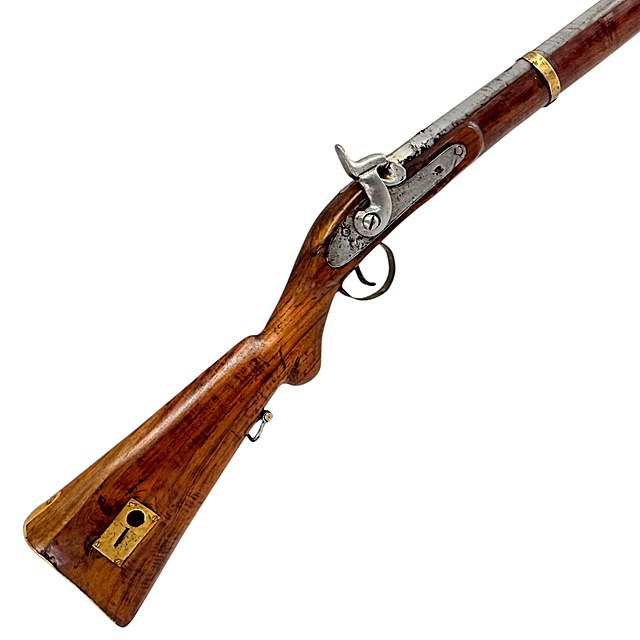
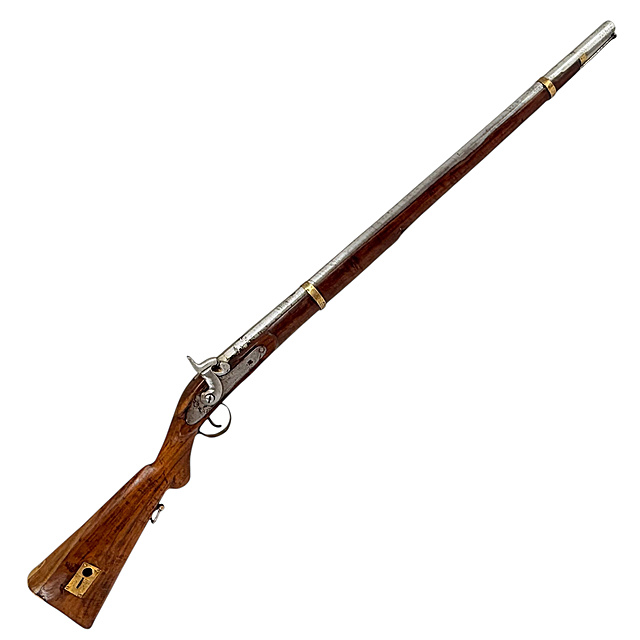
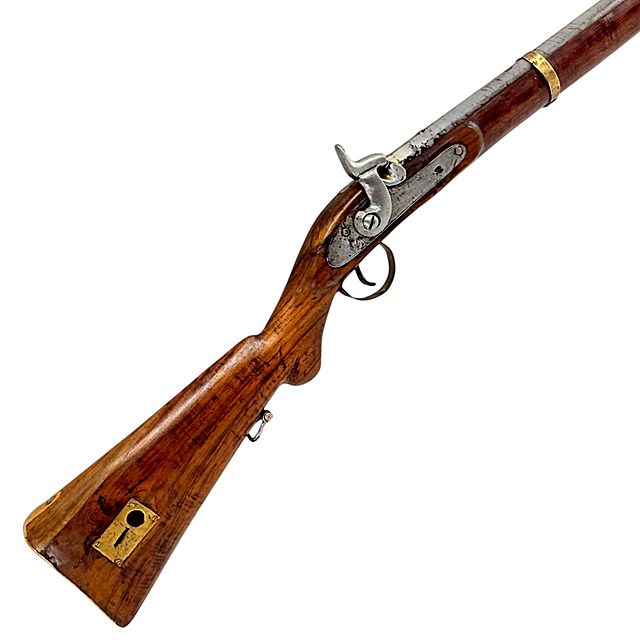
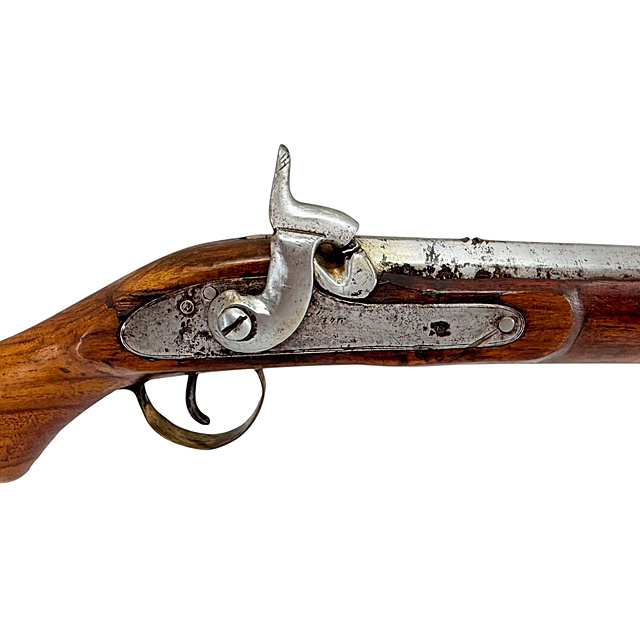
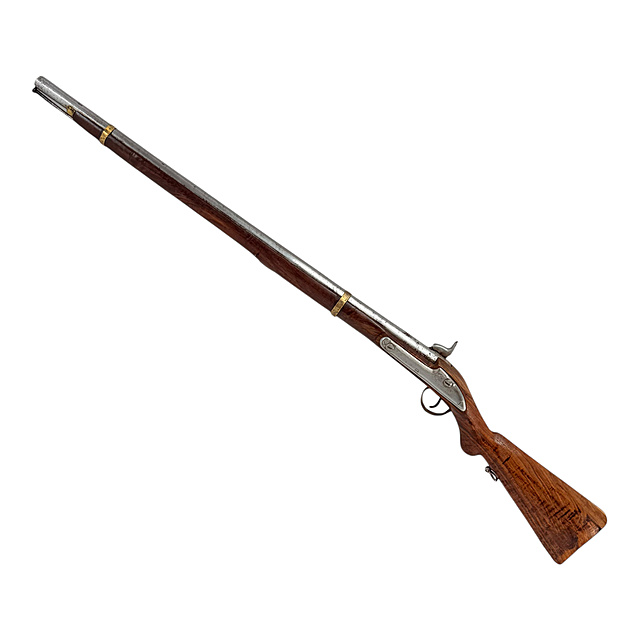
English percussion gun in musket form, full-stocked, with brass barrel bands, circa 1870
Full-stocked gun in musket form, calibre 18 mm. Octagonal barrel, illegibly stamped below the nipple, plain percussion lock with flat, unengraved lock plate, the hammer chequered at the top. Light, reddish-striped full stock reaching nearly to the muzzle, the wrist sharply angled. Two flat brass barrel bands, brass trigger guard, narrow brass butt plate; set into the right flank of the butt the brass plate of a former patchbox, the closure missing. Small iron sling eye. Ramrod present. Condition commensurate with age, mechanism functional, the iron parts extensively rubbed and stained with areas of pitting. Please inspect. L. 122 cm.
The term musket denotes the smoothbore muzzle-loading infantry gun, in use since the 16th century, whose percussion lock replaced the flintlock in the 19th century. In the 19th century Birmingham was the centre of British arms manufacture, with 578 firms in the Gun Quarter in 1868 and the Proof House existing since 1813; besides government contracts, the trade had supplied guns in large numbers since the 18th century for the trade to Africa and to the East India Company. By circa 1870 the British Army had already replaced the percussion muzzle-loaders: in 1866 it introduced the Snider-Enfield as a breech-loader, followed in 1871 by the Martini-Henry. Muzzle-loader exempt from licensing under German law, sale to persons aged 18 and over only.


Lot
Limit:
Your maximum bid: €
by telephone
When bidding by telephone, you will automatically bid the limit or the registered pre-bid (telephone bidding is only possible from €100). Only when the limit/pre-bid has been reached we will call you to bid further on. Your telephone bid will be treated as a written bid up to the registered pre-bid and will of course only be used to the extent necessary.
If you save your absentee bids on the bid list, you will be able to change or delete them until you submit them. If you do not submit your absentee bids, they will not be considered. They must be submitted before the auction starts.
You can submit your absentee bids now using the "Submit absentee bids directly" button, or later using the "List of Bids" menu item.


