
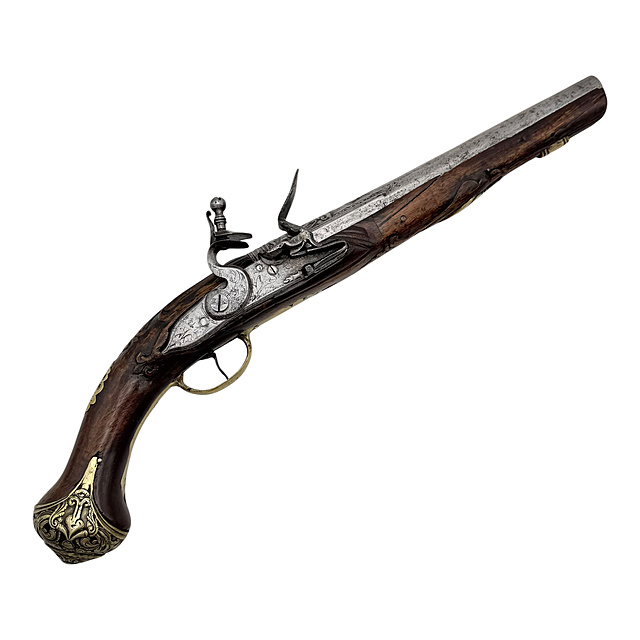
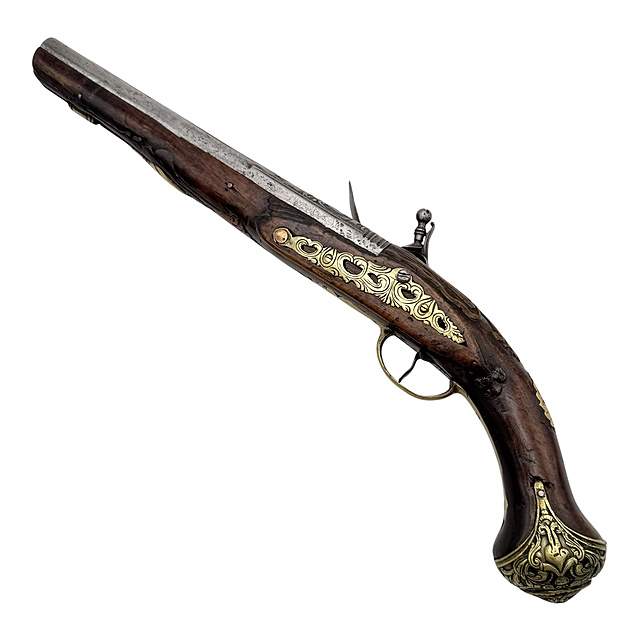
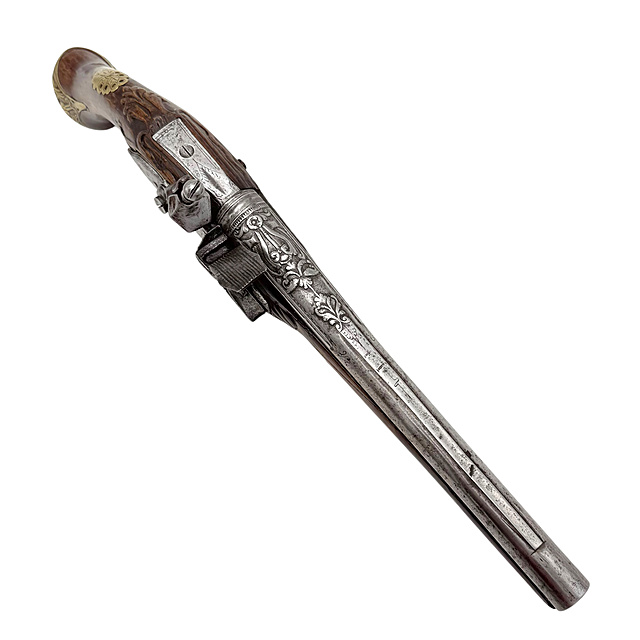
Flintlock cavalry pistol with carved stock and mascaron butt cap, probably mid-18th century
European flintlock cavalry pistol. The long barrel octagonal at the breech and with fine scrolling foliage engraving, passing via a baluster moulding into a round barrel. Lock plate with pointed tail, swan-neck cock and frizzen with scrolling foliage engraving; on the cock screw the stamped number “37”. The full stock of dark wood, ending short of the muzzle, is carved with a raised moulding around lock and tang screw and with scrolling foliage in the grip area; opposite the lock a large pierced and chased brass side plate as well as smaller brass mounts, under the barrel the brass ramrod pipe. The cast brass butt cap with mascaron, shell and scroll decoration, the trigger guard of brass. Age-appropriate condition, the metal parts pitted and stained, the stock with a longitudinal crack on the lock side, the ramrod missing. L. 43 cm
From the 17th century the flintlock superseded the matchlock and remained the common ignition into the 1840s. In the developed form the flint clamped in the cock strikes against the raised steel, which also serves as the pan cover, and opens the pan as it strikes the spark. Cavalry pistols of this size were carried in pairs in holsters on the saddle. Pierced side plates, cast butt caps with mascaron and stocks carved around the lock are part of the furnishing of European Rococo pistols as made in France, Liège and the German states. The pistol is a muzzle-loader with flintlock based on a model predating 1871. Under German weapons law, it may be acquired without a licence from the age of 18.


Lot
Limit:
Your maximum bid: €
by telephone
When bidding by telephone, you will automatically bid the limit or the registered pre-bid (telephone bidding is only possible from €100). Only when the limit/pre-bid has been reached we will call you to bid further on. Your telephone bid will be treated as a written bid up to the registered pre-bid and will of course only be used to the extent necessary.
If you save your absentee bids on the bid list, you will be able to change or delete them until you submit them. If you do not submit your absentee bids, they will not be considered. They must be submitted before the auction starts.
You can submit your absentee bids now using the "Submit absentee bids directly" button, or later using the "List of Bids" menu item.


