
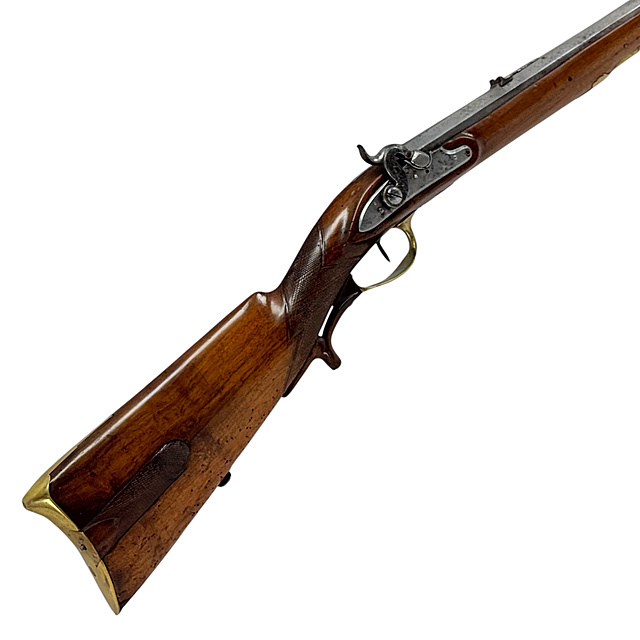
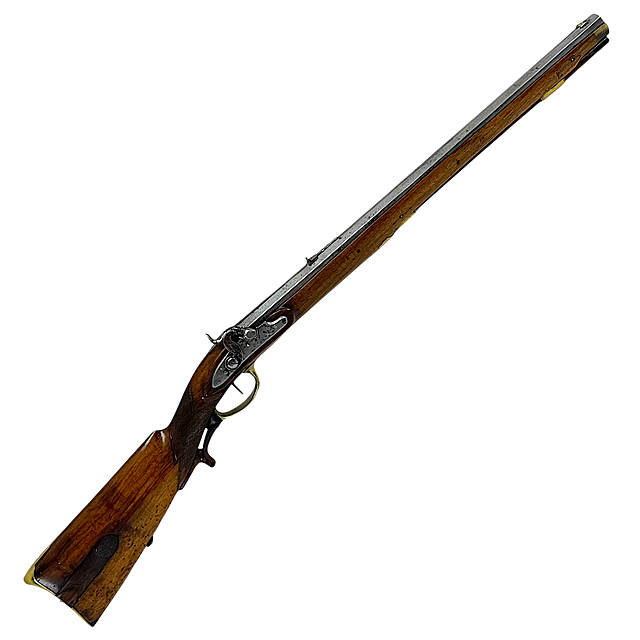
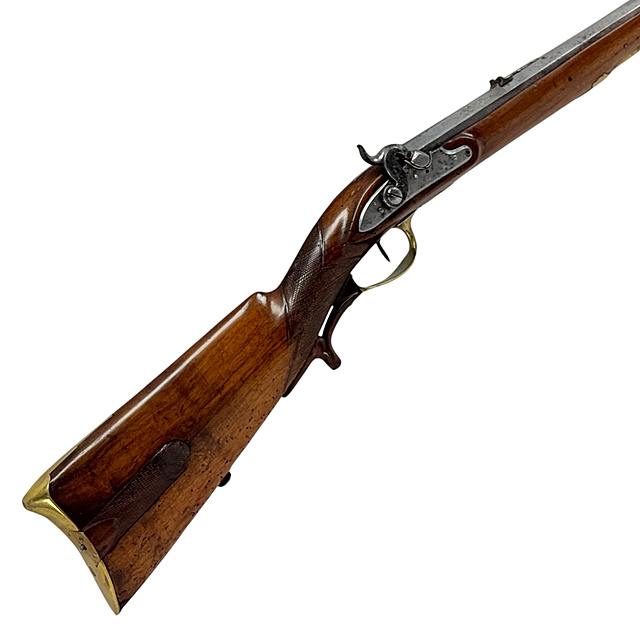
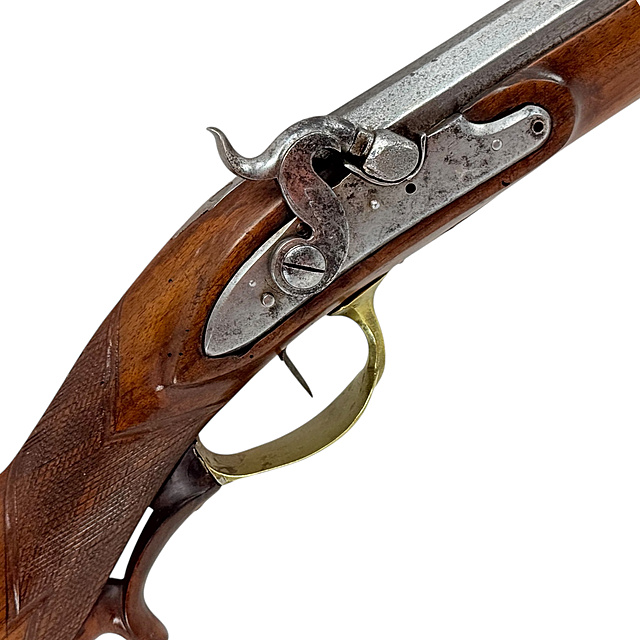
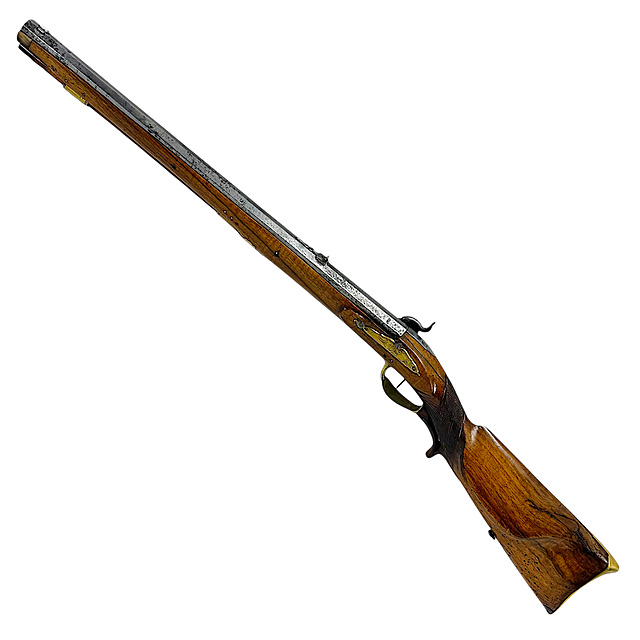
Short hunting rifle (Jäger), carved cheek-piece stock, flintlock converted to percussion, circa 1750
Short hunting rifle (Jäger) in calibre 15 mm with octagonal barrel throughout and leaf sight in the rear third of the barrel. Flintlock converted to percussion: flat lock plate of flintlock form with pointed tail and remaining, partly filled holes of the removed pan parts, S-shaped hammer. Light walnut full stock with German cheek-piece butt, the wrist carved and chequered, on the right side of the butt a patchbox with oval, chequered wooden lid, horn fore-end cap. Brass mounts: trigger guard, butt plate with long upper tang, engraved side plate and ramrod pipe, ramrod present. Age-appropriate condition, mechanism works, barrel with spotty patina and pitted areas, lock pitted, wood with numerous small worm holes. Please inspect. L. 107 cm.
The Jäger rifle (Jägerbüchse), also called Jagdstutzen or Jagdbüchse, originated in Central Europe in the late 17th century: a short hunting weapon with a heavy octagonal barrel, full stock to the muzzle and a compartment in the butt closed with a wooden sliding or hinged lid. This patchbox, also called Kolbenkasten or Kolbenlade, held greased patches for the ball and tools such as a ball puller and cleaning attachment. Further characteristics are the cheek-piece stock with raised cheek rest, the horn fore-end cap and the brass furniture with side plate and ramrod pipe. From the Jäger rifle, German immigrants in Pennsylvania developed the American long rifle, the Pennsylvania or Kentucky rifle, from about 1710. After the introduction of percussion ignition in the 1820s, numerous flintlock rifles were converted: pan and frizzen were removed, the holes in the lock plate closed and a nipple for the percussion cap fitted into the barrel; in this way hunting weapons of the 18th century remained in use until well into the 19th century. Muzzle-loader exempt from licensing under German law, sale to persons aged 18 and over only.


Lot
Limit:
Your maximum bid: €
by telephone
When bidding by telephone, you will automatically bid the limit or the registered pre-bid (telephone bidding is only possible from €100). Only when the limit/pre-bid has been reached we will call you to bid further on. Your telephone bid will be treated as a written bid up to the registered pre-bid and will of course only be used to the extent necessary.
If you save your absentee bids on the bid list, you will be able to change or delete them until you submit them. If you do not submit your absentee bids, they will not be considered. They must be submitted before the auction starts.
You can submit your absentee bids now using the "Submit absentee bids directly" button, or later using the "List of Bids" menu item.


