
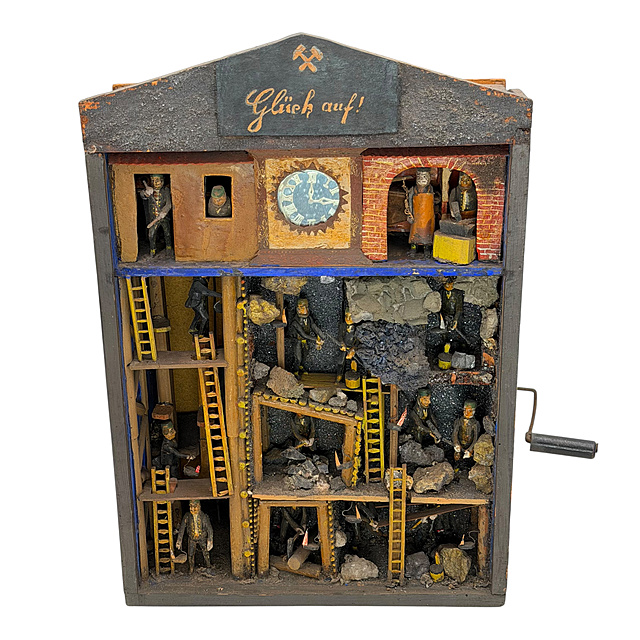
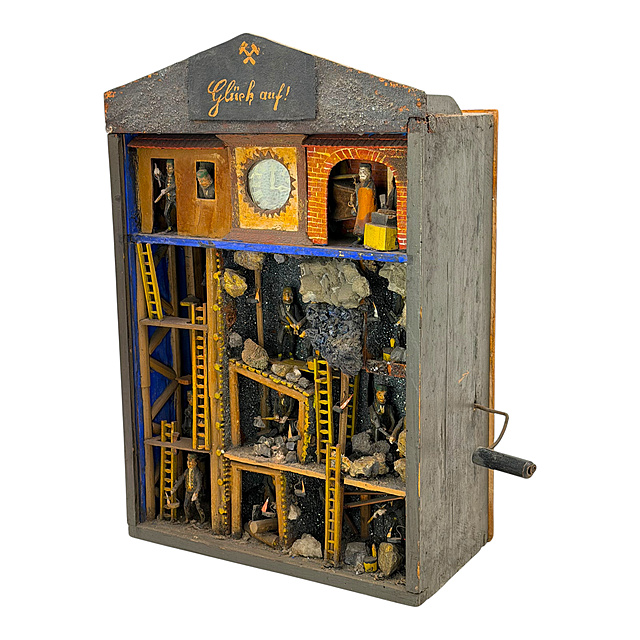
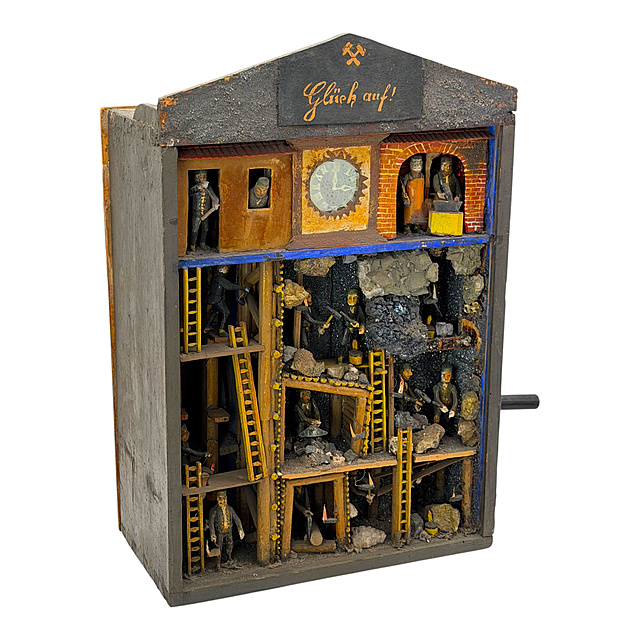
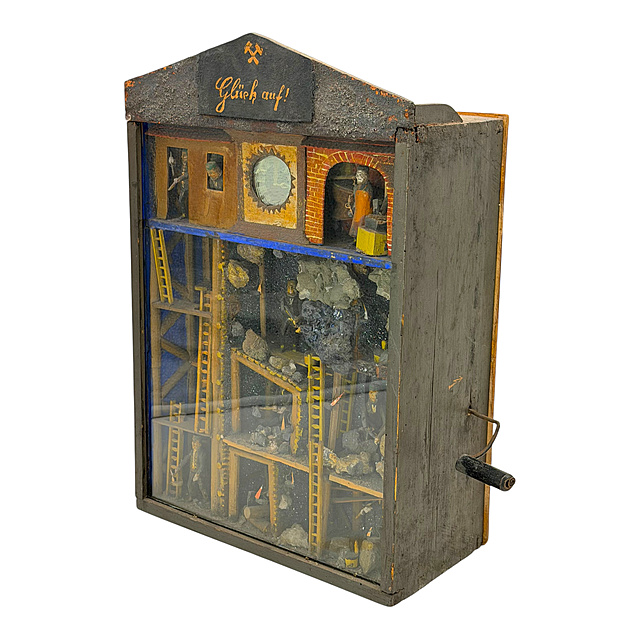
Mechanical Mine in a Display Case, Erzgebirge, Hand Crank with Movable Figures
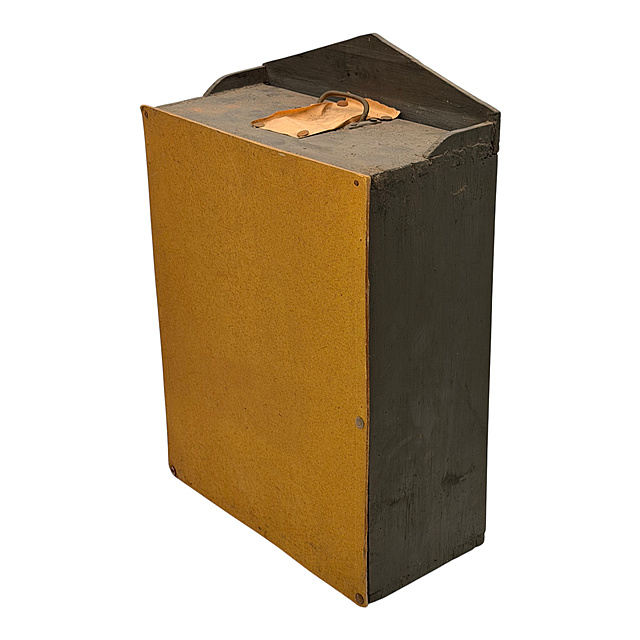
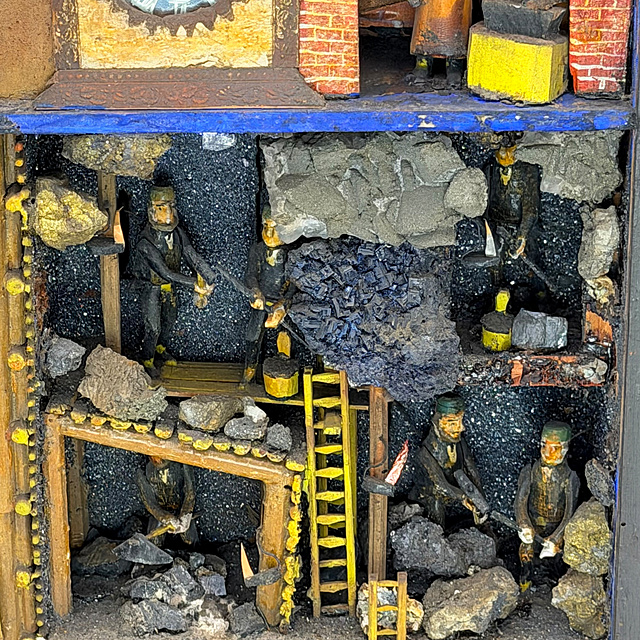
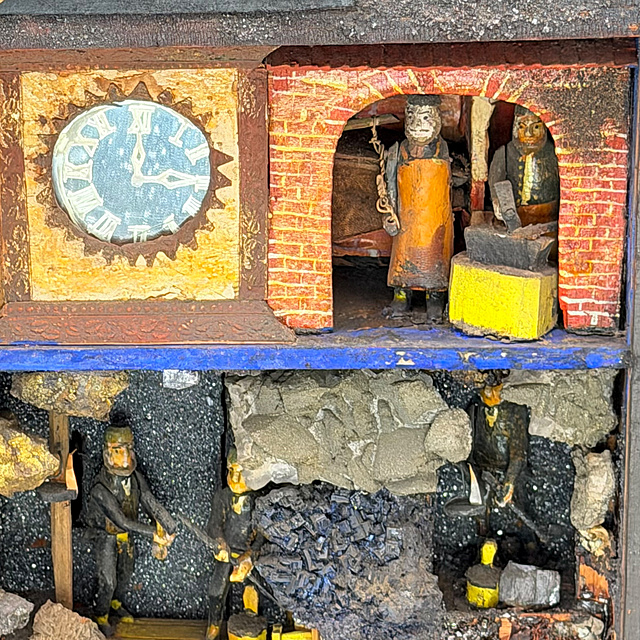
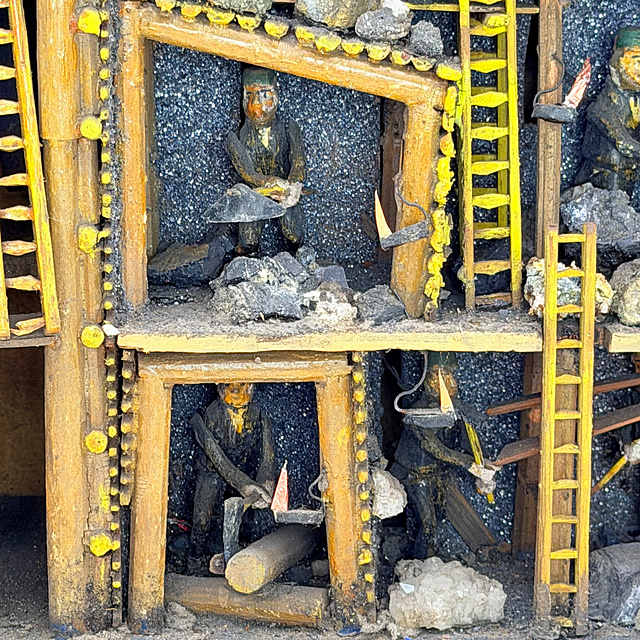
Mining diorama in a dark-finished wooden case behind glass, at the side a hand crank for driving the movable figures. The gable top with a roughened, coal-like surface, on it crossed hammer and chisel in gold and, on a black field, the inscription Glück auf! in gold script. In the upper storey a surface installation with a light house front, a clock with Roman numerals and a brick arch, with figures at work in windows and niches, among others at a workbench and a forge. Below it, over three levels, the mine workings with yellow ladderways, props, tunnel supports and rock masses in which numerous miners with tools and mining lamps are arranged. Back wall of cardboard. Condition commensurate with age, in working order. 43.5x37x14.5 cm.
Mechanical mines in a case are known in the Erzgebirge as Buckelbergwerke because they were carried on the back and demonstrated for a small fee: the miner turned the crank and the scenes of work underground came to life. They arose in the 18th century, when miners who had become unemployed earned their living by carving; the Erzgebirge Christmas mountains came from the same tradition. As early as 1570 a mine model with movable pumps and hoists is recorded in Freiberg. The greeting Glück auf comes from Saxon ore mining and is attested since the 16th century; it means both the hope of a rich yield and of coming back up safely. Hammer and chisel, crossed like a St Andrew's cross, show the tools laid down in front of the mine entrance and thus indicate that all the miners have come up.


Lot
Limit:
Your maximum bid: €
by telephone
When bidding by telephone, you will automatically bid the limit or the registered pre-bid (telephone bidding is only possible from €100). Only when the limit/pre-bid has been reached we will call you to bid further on. Your telephone bid will be treated as a written bid up to the registered pre-bid and will of course only be used to the extent necessary.
If you save your absentee bids on the bid list, you will be able to change or delete them until you submit them. If you do not submit your absentee bids, they will not be considered. They must be submitted before the auction starts.
You can submit your absentee bids now using the "Submit absentee bids directly" button, or later using the "List of Bids" menu item.


