
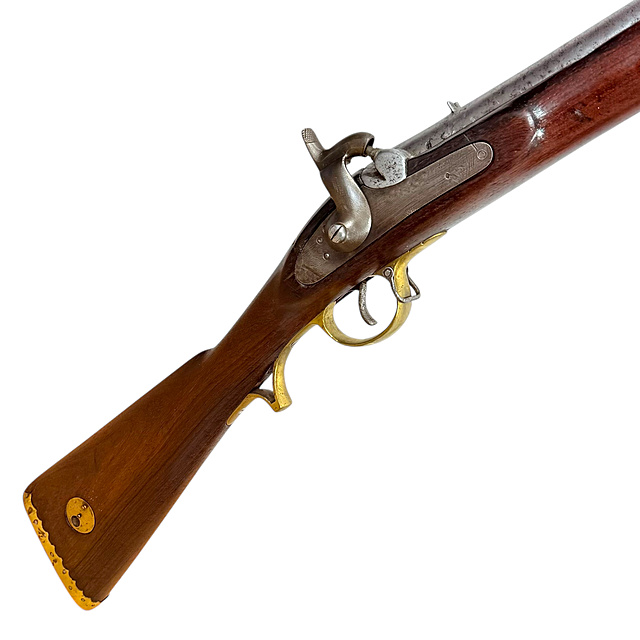
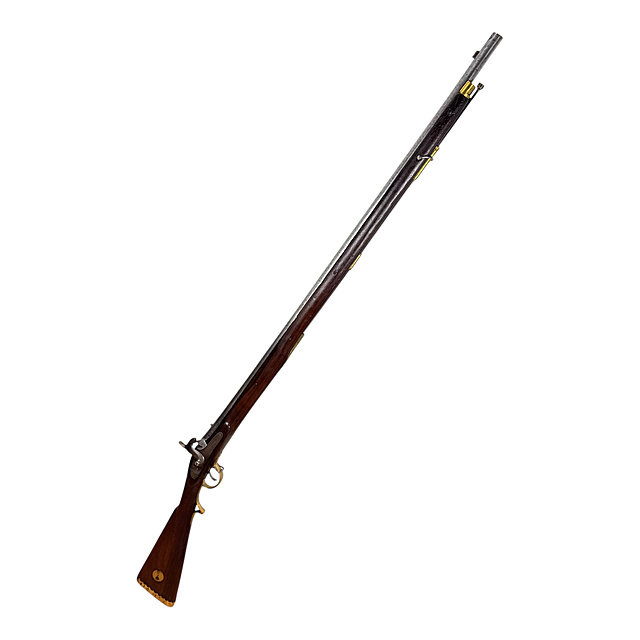
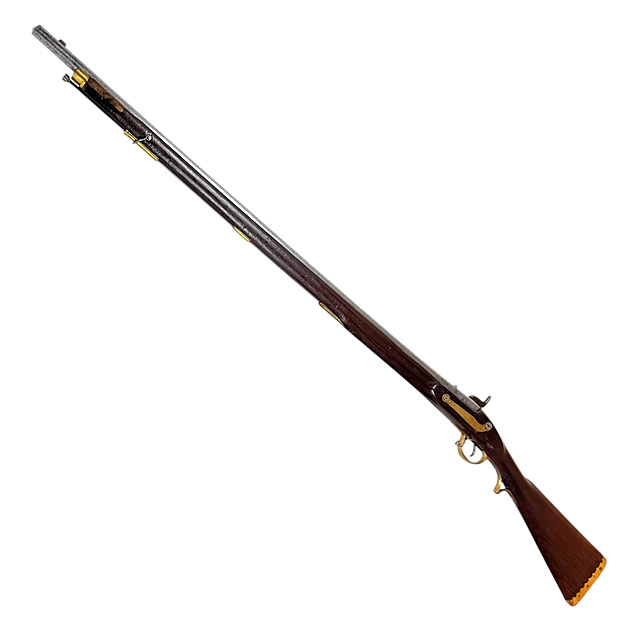
English percussion rifle circa 1850, calibre 19 mm, full walnut stock, brass-coloured mounts
Iron and walnut, fully stocked percussion rifle, muzzleloader, England, circa 1850, calibre 19 mm. Round barrel with rectangular front sight at the muzzle, full walnut stock with brass-coloured forend cap, sling swivel behind it, brass-coloured barrel key escutcheons on the forend, iron ramrod in three brass-coloured pipes. Percussion lock, probably with an old replacement lock plate, flat and rounded at the rear, hammer with grooved thumb spur, nipple, on the opposite side S-shaped curved brass-coloured side plate with two lock screws, brass-coloured trigger guard with long curved rearward extension, brass-coloured butt plate with serrated edge, on the butt a round brass-coloured patchbox with twist closure. Used condition commensurate with age, mechanism working, stained barrel, forend repaired on the left in the area of the ramrod, the repaired area lighter. L. 142 cm, barrel length 101 cm
The percussion lock goes back to the ignition with shock-sensitive priming powder patented by Alexander John Forsyth in 1807, and the percussion cap was added in the late 1810s: the hammer strikes the percussion cap on the nipple and thus ignites the charge in the barrel. Muzzleloaders of this design remained in service until the middle of the 19th century, before breechloaders such as the needle gun replaced them. The curved side plate on the side opposite the lock receives the lock screws, and the barrel key escutcheons on the forend hold the barrel keys. With three ramrod pipes, a serrated butt plate and a patchbox, this rifle carries an extensive set of mounts.


Lot
Limit:
Your maximum bid: €
by telephone
When bidding by telephone, you will automatically bid the limit or the registered pre-bid (telephone bidding is only possible from €100). Only when the limit/pre-bid has been reached we will call you to bid further on. Your telephone bid will be treated as a written bid up to the registered pre-bid and will of course only be used to the extent necessary.
If you save your absentee bids on the bid list, you will be able to change or delete them until you submit them. If you do not submit your absentee bids, they will not be considered. They must be submitted before the auction starts.
You can submit your absentee bids now using the "Submit absentee bids directly" button, or later using the "List of Bids" menu item.


