
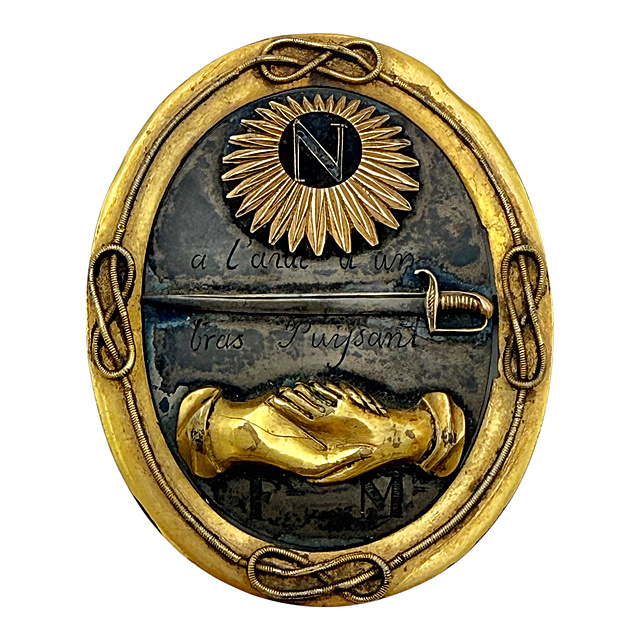
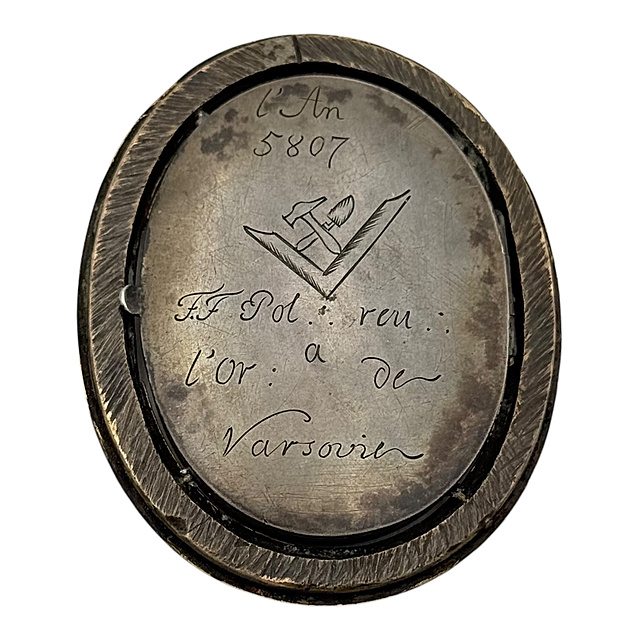
Freemason's medallion of the Warsaw lodge Les Frères Polonais Réunis, radiant star "N", dated 1807
Gold-coloured and silver-coloured metal, Freemason's medallion, also known as a lodge jewel, historical medallion from Warsaw, early 19th century, with Masonic dating "l'An 5807" (1807), hinged oval medallion, the front with broad gold-coloured border and a surrounding wire cord laid in loops and knots, dark central field with applied gold-coloured radiant star enclosing the letter "N", probably for Napoleon, below it a two-line engraved inscription in cursive script, in between an applied sword with gold-coloured hilt, at the bottom two clasped hands in gold-coloured relief, below them the engraved monogram "F M" (F∴M∴, Masonic abbreviation for Franc-Maçon, Freemason), the reverse with a plain oval silver-coloured plate within a line-engraved border, engraved with a square enclosing a crossed hammer and trowel, and "F.F Pol∴ reu∴ a l'Or: de Varsovie", condition commensurate with age, 5.5x4.5 cm (HxW).
The lodge Les Frères Polonais Réunis (The United Polish Brothers) was founded in Warsaw in 1807, a few months after the Peace of Tilsit and the establishment of the Duchy of Warsaw; its members were predominantly military men who had been initiated in French lodges, and it maintained close ties with the Grand Orient de France. The National Grand Orient of the Duchy of Warsaw emerged from this milieu in 1810. The formula "à l'Orient de Varsovie" denotes the seat of the lodge, and the year 5807 follows the Masonic Anno Lucis reckoning, which adds 4000 years to the civil year. Polish Freemasonry of these years was marked by a pronounced cult of Napoleon, linked to the hope of restoring Poland; the letter N, often accompanied by a laurel wreath or a crown, was the most widespread emblem of Napoleonic symbolism and appeared on medals, tableware, furniture and textiles.


Lot
Limit:
Your maximum bid: €
by telephone
When bidding by telephone, you will automatically bid the limit or the registered pre-bid (telephone bidding is only possible from €100). Only when the limit/pre-bid has been reached we will call you to bid further on. Your telephone bid will be treated as a written bid up to the registered pre-bid and will of course only be used to the extent necessary.
If you save your absentee bids on the bid list, you will be able to change or delete them until you submit them. If you do not submit your absentee bids, they will not be considered. They must be submitted before the auction starts.
You can submit your absentee bids now using the "Submit absentee bids directly" button, or later using the "List of Bids" menu item.


