
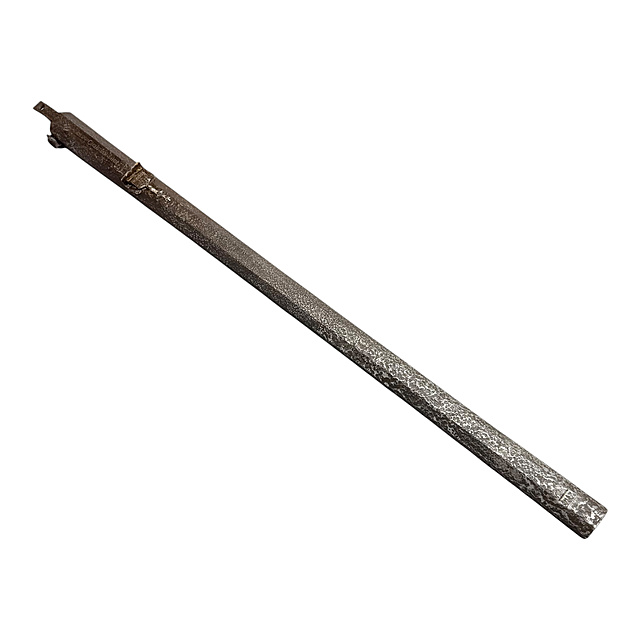
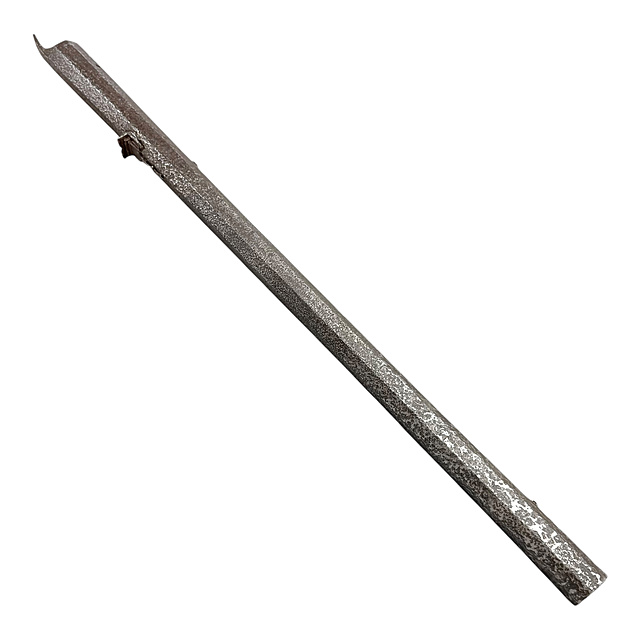
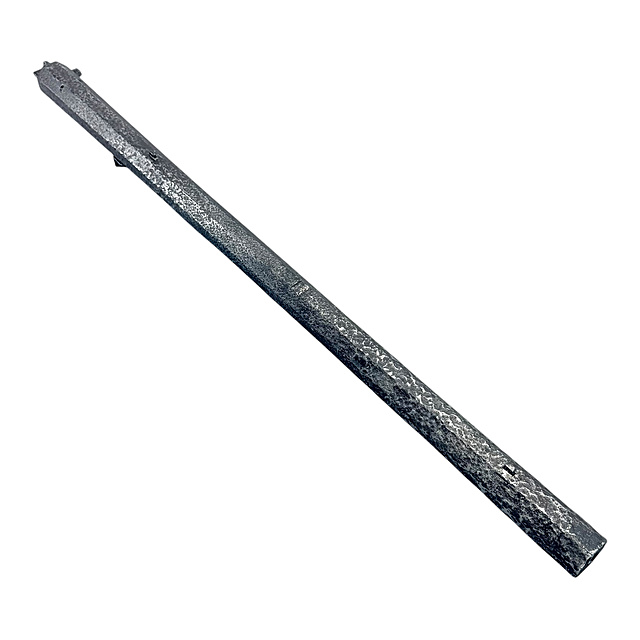
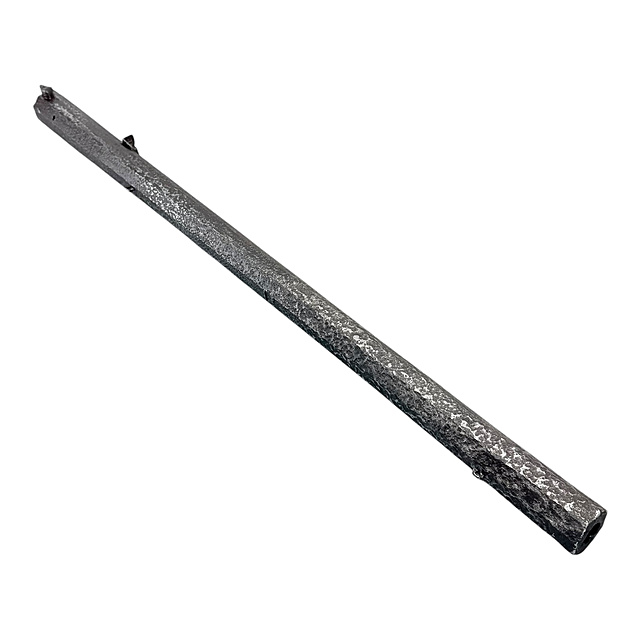
Johann Christian Jahn, Wernigerode, octagonal barrel of a wall gun, circa 1750, no stock or lock
Iron with gold-coloured inlay, heavy, fully octagonal smoothbore barrel of a wall gun, without stock and lock, converted to percussion, calibre 20 mm. On the upper octagonal face at the breech the name "IOHANN·CHRISTIAN·IAHN" inlaid in gold colour in capitals, near the breech a rectangular rear-sight cut-out with remains of the standing sight, near the muzzle the transverse slot for the front sight, front sight missing. Breech plug with flat, pierced tang, at the side of the breech the nipple, two barrel lugs on the underside for the cross pins of the stock, surface pitted by corrosion over the entire length. L. 102 cm
The gold-coloured inlaid name on the upper octagonal face refers to Johann Christian Jahn, also spelt Jann, who worked as an air gun maker in Wernigerode in the Harz around 1750; gunmakers set such names on their barrels as a signature, and air gun makers such as Friedrich Jacob Boßler in Darmstadt built firearms as well as air guns. Heavy, thick-walled octagonal barrels with calibres of about 18 to 21 mm characterise the wall gun, the fortress weapon for long ranges, which because of its weight and recoil was not fired from the shoulder but rested on the parapet or a stand; the recoil hook of the older hook guns is absent on many pieces of the 18th and 19th c. With percussion ignition, in which the hammer strikes a percussion cap on the nipple, many older muzzleloaders remained in use in the 19th century; the cap system goes back to the patent of Alexander John Forsyth of 1807. Literature: Heer, Der neue Stöckel, 1978, p. 584.


Lot
Limit:
Your maximum bid: €
by telephone
When bidding by telephone, you will automatically bid the limit or the registered pre-bid (telephone bidding is only possible from €100). Only when the limit/pre-bid has been reached we will call you to bid further on. Your telephone bid will be treated as a written bid up to the registered pre-bid and will of course only be used to the extent necessary.
If you save your absentee bids on the bid list, you will be able to change or delete them until you submit them. If you do not submit your absentee bids, they will not be considered. They must be submitted before the auction starts.
You can submit your absentee bids now using the "Submit absentee bids directly" button, or later using the "List of Bids" menu item.


