
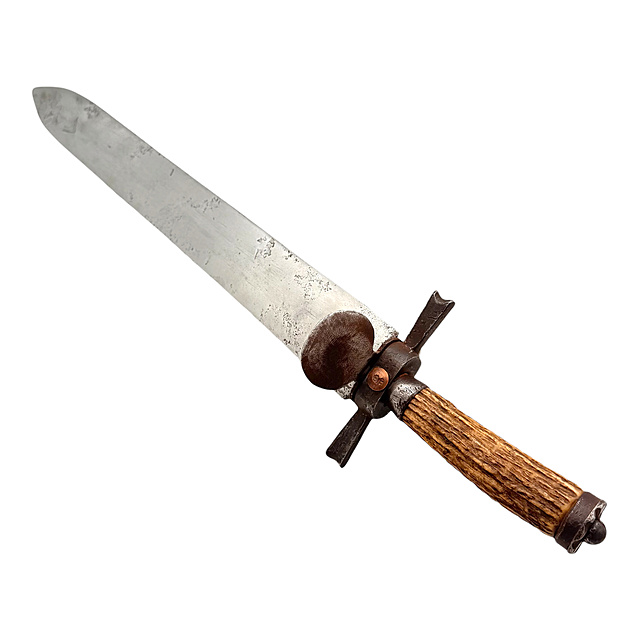
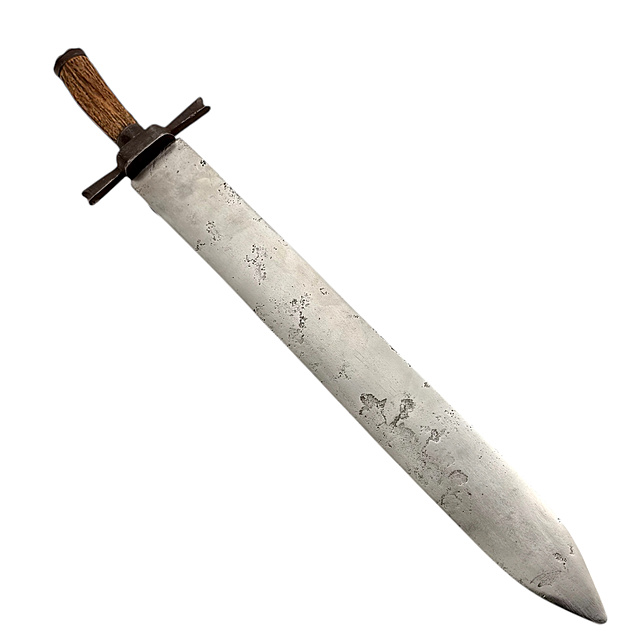
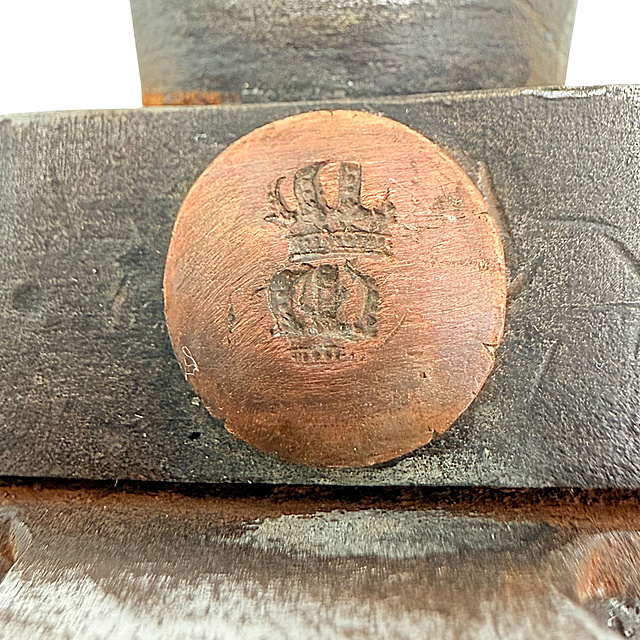
Hunting cleaver (Waidpraxe), iron hilt, staghorn grip, copper double-crown mark, 18th/19th century
Steel, iron, copper, staghorn. Hunting cleaver (Waidpraxe, Praxe) with broad, slightly bellied back-edged blade tapering to a point. Iron cross hilt with straight quillons split at the ends and round shell guard at the blade root; in the centre piece of the hilt an inset round copper plaque with double crown, two crowns struck one above the other. Staghorn grip with iron pommel cap with ball finial. Without scabbard. Blade cleaned, with rust pitting, the iron with age patina. L. 57 cm, blade length 43.5 cm, blade width approx. 5 cm.
The Waidpraxe, Praxe for short, is the heavy chopping knife of courtly hunting, a special form of the billhook, and from the 16th century formed the principal piece of the hunting trousse (Waidbesteck) with which the killed game was broken up: the broad blade served for cutting up, the small knives, fork and awl carried in the scabbard for gutting. Characteristic of the type are the heavy single-edged blade with broad back, the iron cross hilt and the staghorn grip; smiths' marks in copper inlay are recorded on Saxon Waidpraxen of the 17th century. Particularly many such hunting trousses have survived from Saxony: a hunting trousse made in Dresden with the arms and initials of Elector Christian II from 1609 is held by the Art Institute of Chicago, another from the 18th century by the arms collection of the von Pückler family at Branitz Castle. In hunting, the Praxe stood alongside the hunting hanger, which served for dispatching the game.


Lot
Limit:
Your maximum bid: €
by telephone
When bidding by telephone, you will automatically bid the limit or the registered pre-bid (telephone bidding is only possible from €100). Only when the limit/pre-bid has been reached we will call you to bid further on. Your telephone bid will be treated as a written bid up to the registered pre-bid and will of course only be used to the extent necessary.
If you save your absentee bids on the bid list, you will be able to change or delete them until you submit them. If you do not submit your absentee bids, they will not be considered. They must be submitted before the auction starts.
You can submit your absentee bids now using the "Submit absentee bids directly" button, or later using the "List of Bids" menu item.


