
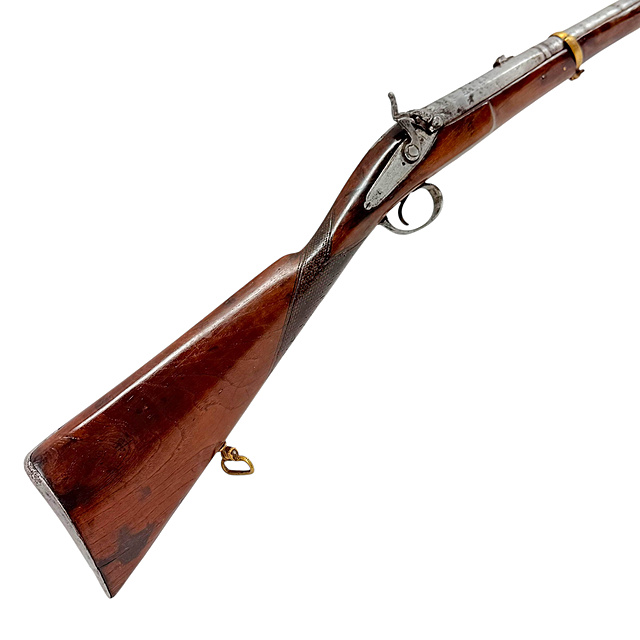
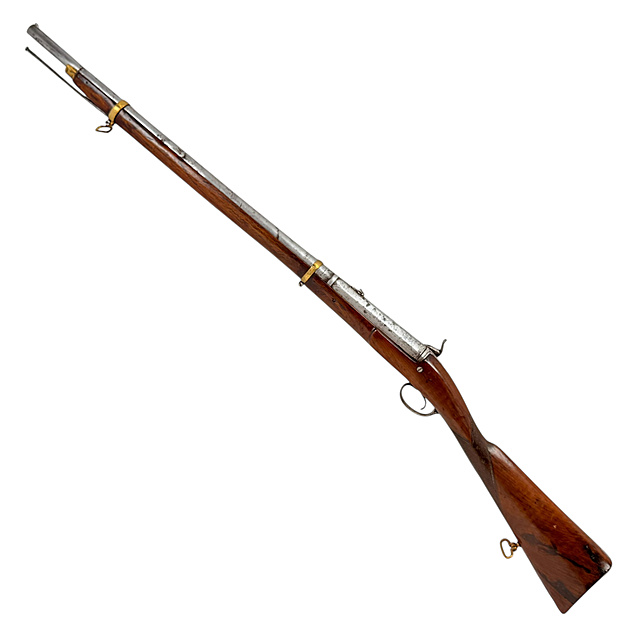
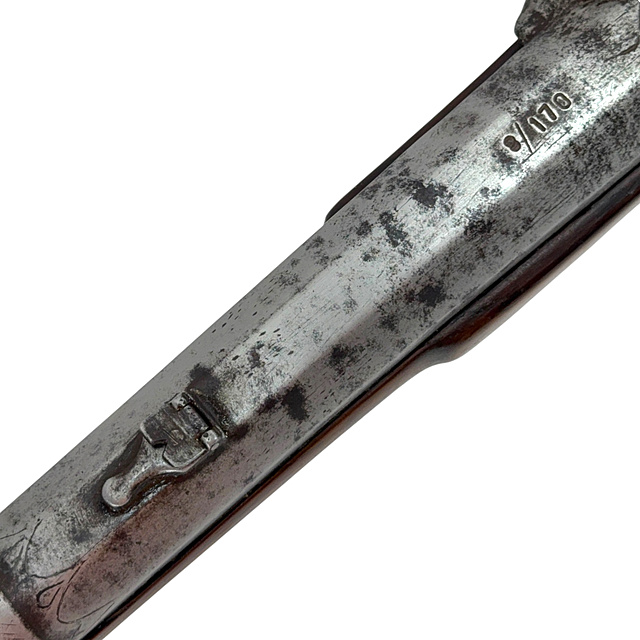
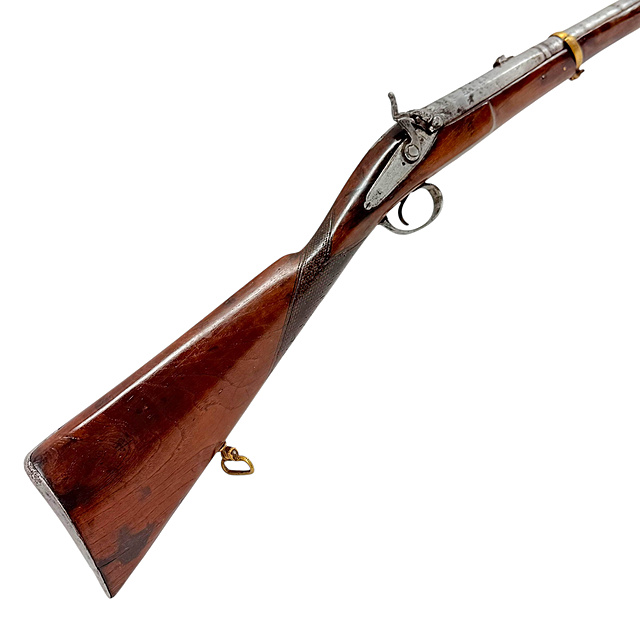
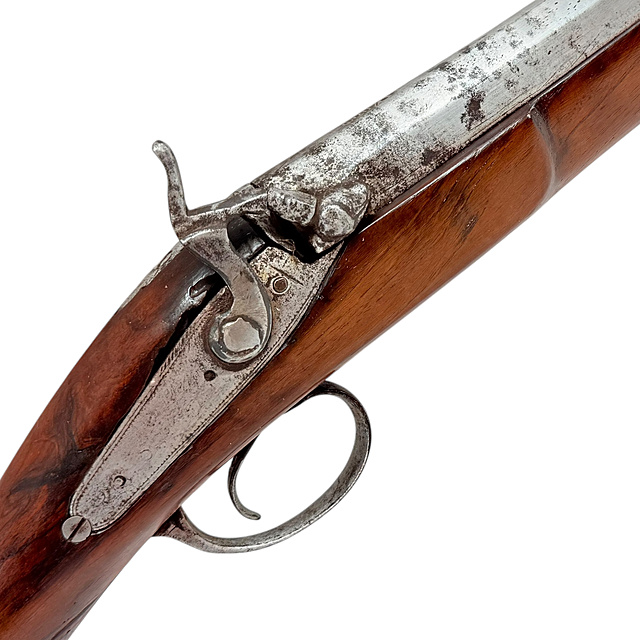
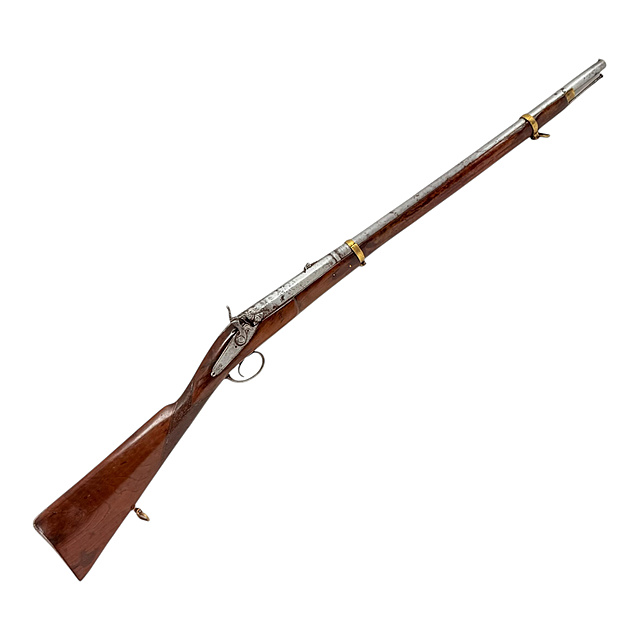
English percussion gun with back-action lock, full stock, brass barrel bands, stamped number “8/170”
Gun in calibre 16 mm with barrel octagonal at the breech, round towards the front, stamped there “8/170”, folding rear sight in front of the breech. Percussion back-action lock (rear-mounted lock), hammer with curved spur, lock plate with dot and line border engraving, light scroll engraving at the barrel base. Reddish-brown walnut full stock to just short of the muzzle, wrist chequered. Two flat brass barrel bands, sling swivel, iron trigger guard with scrolled spur, ramrod present. Age-appropriate condition, mechanism works, metal parts heavily pitted over large areas, wood with signs of use and scratches, chequering rubbed. Please inspect. L. 120 cm.
The back-action lock, in German Rückschloss, carries the mainspring behind the hammer in the wrist and not, like the bar-action lock, in front of it on the lock bar; it allows a slimmer stock behind the barrel. This lock form appeared in England in the early 1830s, was used on percussion guns, shotguns and pistols and, with the Brunswick Rifle of 1837, also reached British service weapons, which likewise feature a full stock, brass furniture, border engraving on the lock and a folding rear sight. In the 19th century the centres of English gunmaking were London and Birmingham, where gunmakers made both service weapons for the army and hunting and trade weapons. There, from the 1820s, percussion ignition with the percussion cap replaced flintlock ignition with flint, pan and priming powder. Muzzle-loader exempt from licensing under German law, sale to persons aged 18 and over only.


Lot
Limit:
Your maximum bid: €
by telephone
When bidding by telephone, you will automatically bid the limit or the registered pre-bid (telephone bidding is only possible from €100). Only when the limit/pre-bid has been reached we will call you to bid further on. Your telephone bid will be treated as a written bid up to the registered pre-bid and will of course only be used to the extent necessary.
If you save your absentee bids on the bid list, you will be able to change or delete them until you submit them. If you do not submit your absentee bids, they will not be considered. They must be submitted before the auction starts.
You can submit your absentee bids now using the "Submit absentee bids directly" button, or later using the "List of Bids" menu item.


