
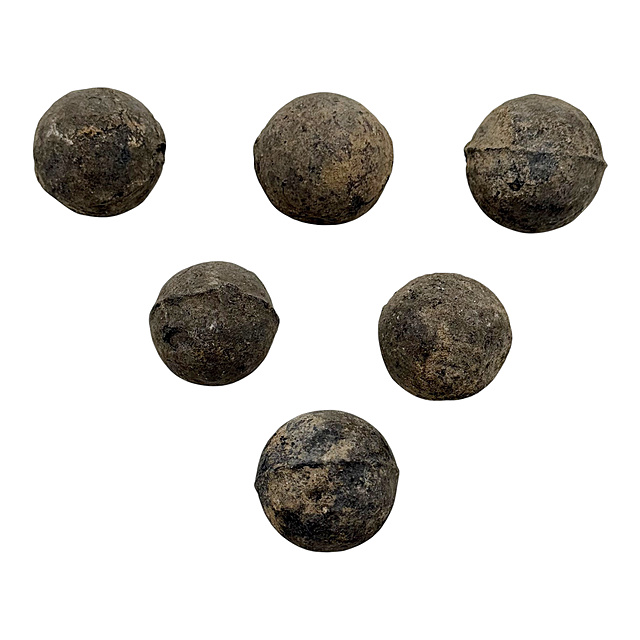
Six cannonballs for a culverin, iron slag, Herzog Julius Hütte Langelsheim, circa 1575
Iron slag, six balls for a culverin, Herzog Julius Hütte, Langelsheim, Braunschweig / Wolfenbüttel, circa 1575. Lot of six historical cannonballs with grey-brown, rough and porous surface, all with a circumferential casting seam. The balls come from a filled-in ditch in Wolfenbüttel which was repaired in the 1960s. Preservation commensurate with age. D. 4 to 5 cm, weight 183 to 241 g per ball.
Duke Julius of Brunswick-Wolfenbüttel (1528-1589) reigned from 1568, promoted mining and smelting in the Harz and made the Oker navigable between Wolfenbüttel and the Harz. In 1569 he introduced a new artillery ammunition, balls cast from the slag of the Harz metal smelters. They were produced until 1585 in the Frau-Sophienhütte and in the Herzog-Juliushütte near Astfeld, founded in 1575, today part of Langelsheim, where ores from the Rammelsberg near Goslar were smelted. In 1572 alone, 54,000 of these projectiles reached Wolfenbüttel, with a further 73,000 held in store. The slag balls saved iron but often broke on firing or shortly after leaving the gun barrel.


Lot
Limit:
Your maximum bid: €
by telephone
When bidding by telephone, you will automatically bid the limit or the registered pre-bid (telephone bidding is only possible from €100). Only when the limit/pre-bid has been reached we will call you to bid further on. Your telephone bid will be treated as a written bid up to the registered pre-bid and will of course only be used to the extent necessary.
If you save your absentee bids on the bid list, you will be able to change or delete them until you submit them. If you do not submit your absentee bids, they will not be considered. They must be submitted before the auction starts.
You can submit your absentee bids now using the "Submit absentee bids directly" button, or later using the "List of Bids" menu item.


