
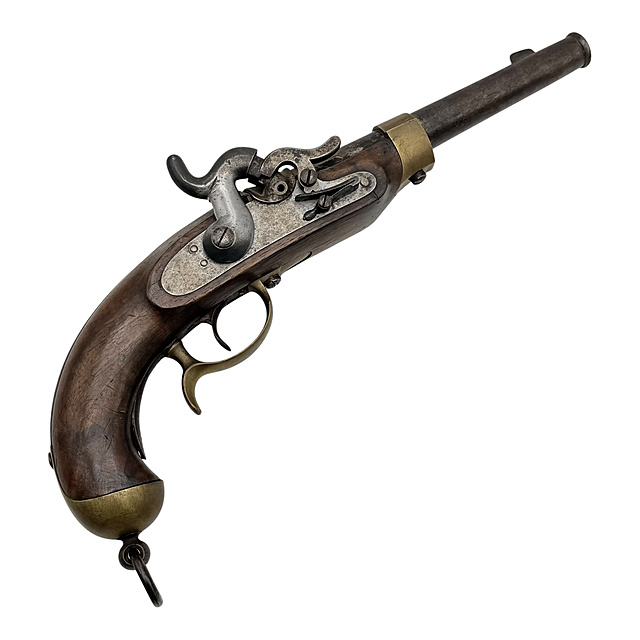
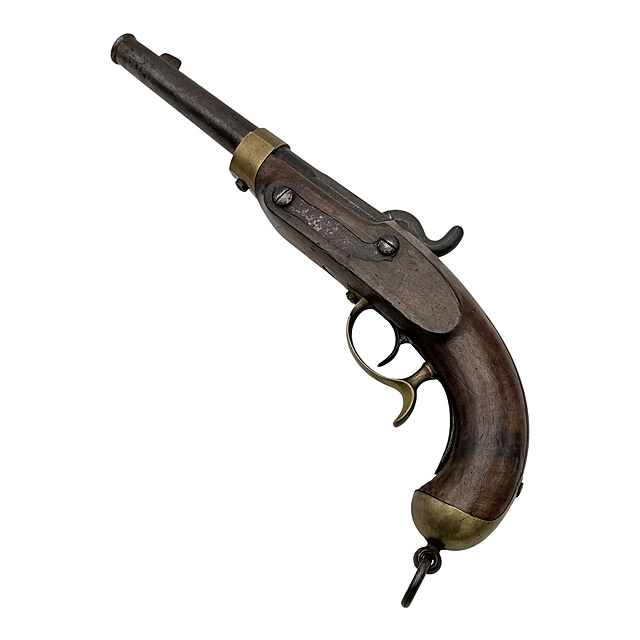
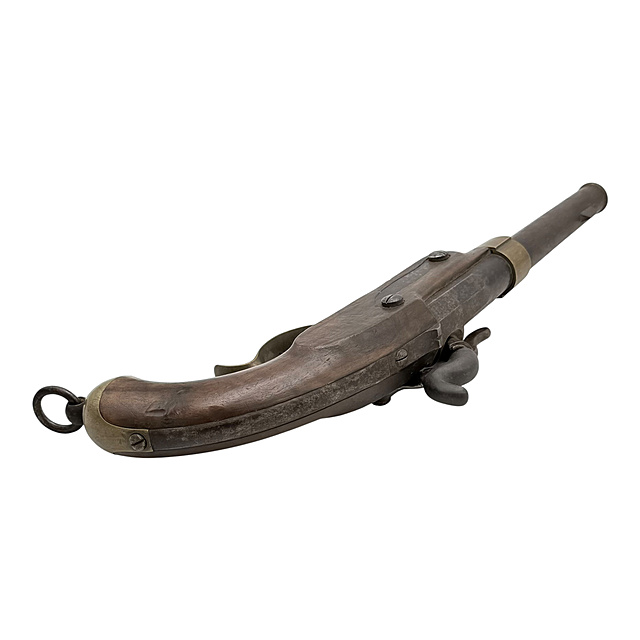
Cavalry pistol, probably Prussia M 1823 U/M, converted from flintlock to percussion, 19th century
Wood and metal, cavalry pistol, muzzle-loader, probably Prussian model 1823, converted from flintlock to percussion (U/M) and probably shortened after the manner of the cavalry pistol M 1850, traces of the former pan on the lock, barrel with octagonal breech section, turning to round, swamped muzzle, front sight and fixed rear sight on the breech plug tang, percussion lock with flat lock plate, hammer, nipple and spring-loaded nipple safety in place of the frizzen, dark half stock, S-shaped side plate, back of the grip with metal strap, brass-coloured mounts comprising barrel band, trigger guard with finger spur and butt cap with ring for the lanyard, cal. 15 mm, probably 2nd quarter of the 19th century, conversion probably 1850s, used condition commensurate with age, mechanism works, L. 39 cm
The Prussian cavalry pistol introduced in 1823 was made in Potsdam, Neisse, Saarn, Danzig and Suhl and converted to percussion ignition in the early 1850s (officially “Umgeändertes Modell”, U/M); in the process the nipple safety took the place of the frizzen, and some of the pistols received the shortened half stock with barrel band after the manner of the cavalry pistol M 1850 introduced in 1850. The converted pistols remained in use alongside the M 1850 with uhlans, cuirassiers and artillery until the war of 1870/71. The percussion lock goes back to the patent of Alexander John Forsyth of 1807; with the copper percussion cap it replaced the flintlock, was introduced by the armies in the 1830s and 1840s and was superseded by breech-loaders from the 1860s onwards. As a percussion pistol of a model predating 1871, it may be acquired and possessed without a licence under German weapons law from the age of 18; this also applies to a reproduction.


Lot
Limit:
Your maximum bid: €
by telephone
When bidding by telephone, you will automatically bid the limit or the registered pre-bid (telephone bidding is only possible from €100). Only when the limit/pre-bid has been reached we will call you to bid further on. Your telephone bid will be treated as a written bid up to the registered pre-bid and will of course only be used to the extent necessary.
If you save your absentee bids on the bid list, you will be able to change or delete them until you submit them. If you do not submit your absentee bids, they will not be considered. They must be submitted before the auction starts.
You can submit your absentee bids now using the "Submit absentee bids directly" button, or later using the "List of Bids" menu item.


