
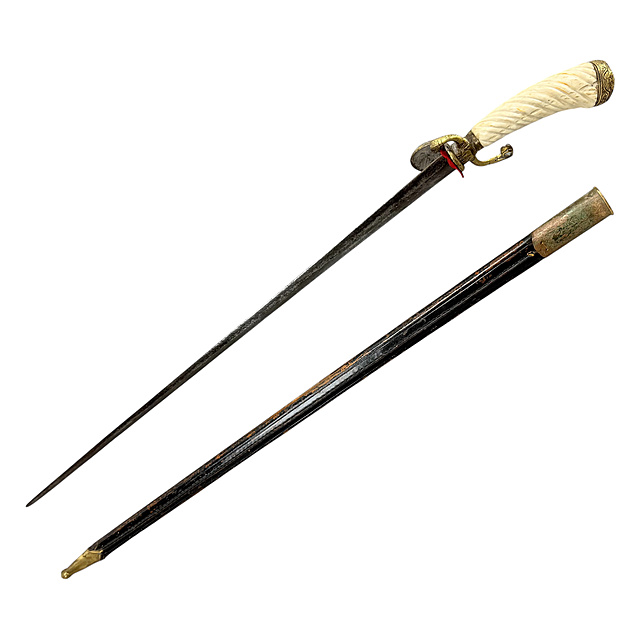
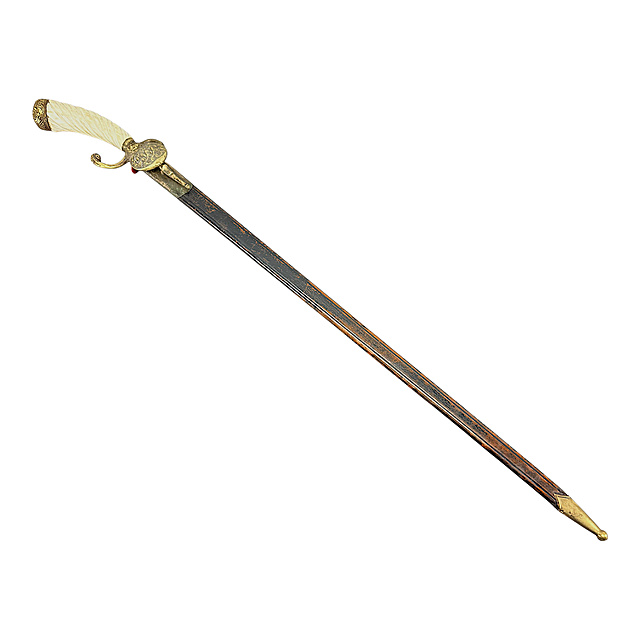
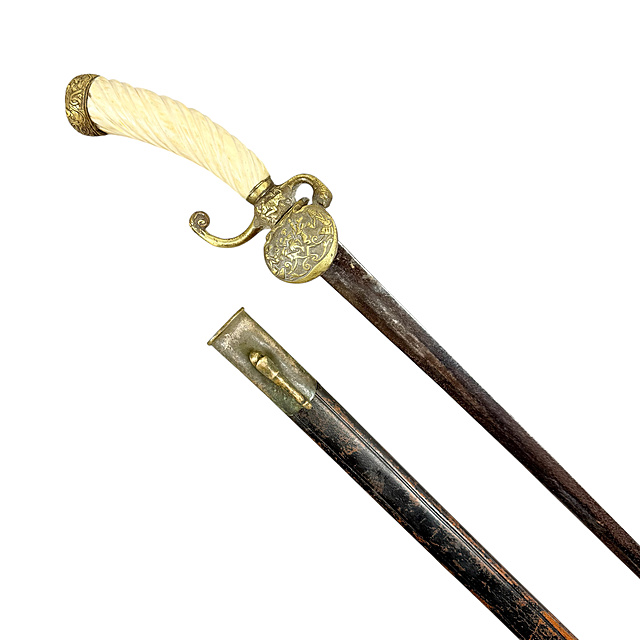
Hunting hanger with twisted bone grip and figural brass hilt, leather-covered scabbard, 19th century
Bone, brass, steel, leather. Hunting hanger, in hunting usage also called Jagdplaute, with light-coloured, spirally twisted bone grip and brass hilt. Shell-shaped shell guard with hunting scene in relief: a man with hunting horn, a hunter with a stag, on the far right a further hunter with hunting horn and a dog; the knuckle guard with relief decoration, the quillon scrolled into a volute and decorated with a dog laying its paw on a hare; pommel cap with foliate scroll relief. Narrow, straight back-edged blade. Leather-covered scabbard with brass locket with frog stud and brass chape, the leather rubbed. Good condition commensurate with age. L. 82 cm, blade length 63 cm.
Typologically the hunting hanger developed from the hunting sword; in the 18th century it became slimmer and shorter and, as the side arm of the skilled huntsman, was the weapon for dispatching the bayed game with a thrust to the heart; unlike the hunting rapier and the hunting sabre it was used only on foot. From the Baroque period onwards brass and silver replaced the iron hilts, the grips were made of staghorn or bone, and shell guard and quillons remained small from the 18th century onwards. Cast hunting scenes with stag, hunter and dog on the shell guard and the dog chasing the hare on the hilt have belonged to the established repertoire of motifs of German hunting edged weapons since the late 17th century. The hunting weapon was worn in a leather scabbard on the sword belt on the left side, which often held a by-knife, the Nicker or Genickfänger. From the 18th century onwards the hunting hanger was also part of the service uniform of forestry officials and thus became a representative and uniform weapon.


Lot
Limit:
Your maximum bid: €
by telephone
When bidding by telephone, you will automatically bid the limit or the registered pre-bid (telephone bidding is only possible from €100). Only when the limit/pre-bid has been reached we will call you to bid further on. Your telephone bid will be treated as a written bid up to the registered pre-bid and will of course only be used to the extent necessary.
If you save your absentee bids on the bid list, you will be able to change or delete them until you submit them. If you do not submit your absentee bids, they will not be considered. They must be submitted before the auction starts.
You can submit your absentee bids now using the "Submit absentee bids directly" button, or later using the "List of Bids" menu item.


