
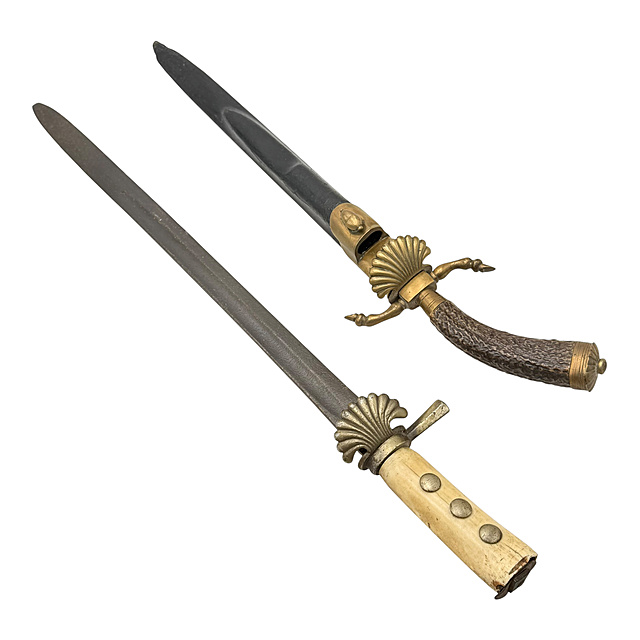
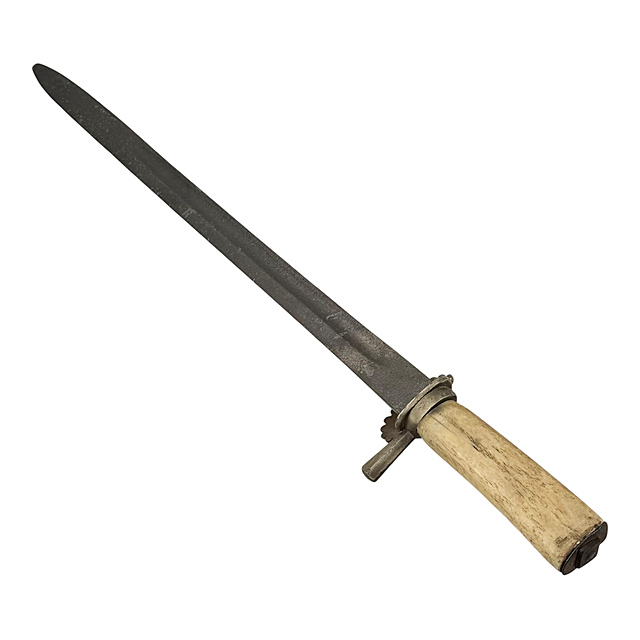
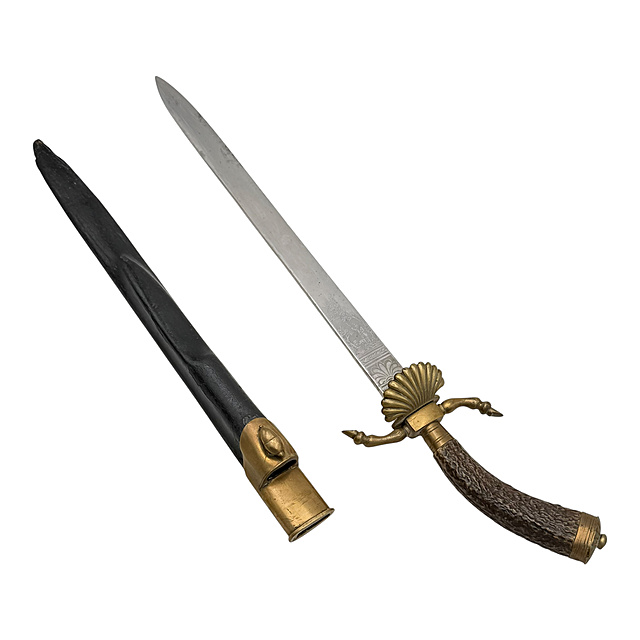
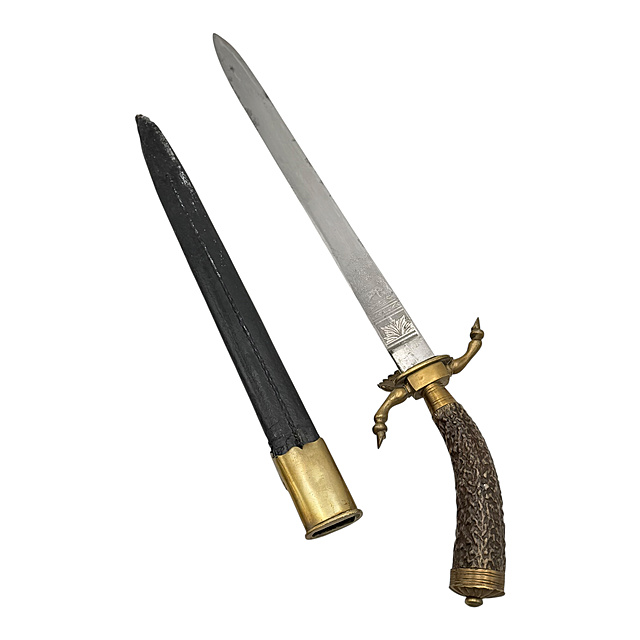
Bone-grip hunting knife and staghorn hunting hanger, etched, probably 2nd half of the 19th century
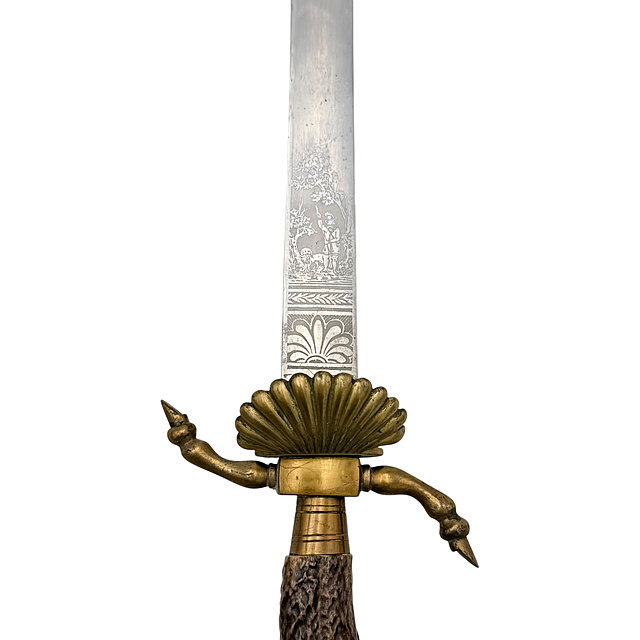
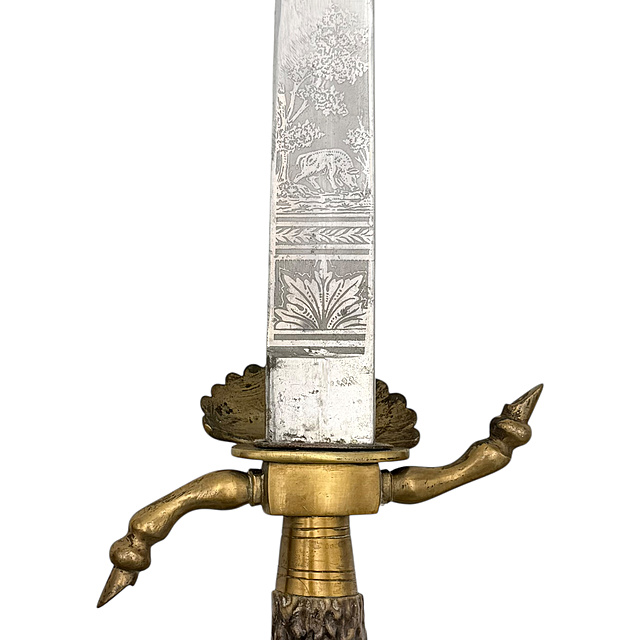
Two hunting knives in the form of hunting hangers, condition commensurate with age. 1) Hunting knife with bone grip with three hemispherical decorative rivets, hilt probably of white metal with small shell-shaped shell guard and short straight crossguard, the crossguard broken off on one side, the hilt bent; straight back-edged blade with fuller and rounded point, corroded overall, grip loose, end of grip chipped, without scabbard, L. 58 cm, blade length 46 cm. 2) Hunting hanger, probably Kirschbaum, Solingen, with staghorn grip, brass-coloured, shell-shaped shell guard and below it a crossguard with two arms curved in opposing S-shapes in the form of deer's legs; at the blade root, concealed by the shell guard, the punched mark knight's head with helmet in profile; the straight back-edged blade etched on both sides, on one side with a hunter with dog under a tree, on the other with a rooting wild boar. Black leather scabbard with brass-coloured locket and pocket, the small by-knife missing. Blade stained, etching rubbed in places, L. 50 cm, blade length 34 cm.
In the 19th century the hunting hanger was part of the huntsman's equipment and was worn with hunting dress both for dispatching game and as a mark of status. The pocket on the scabbard held a small by-knife for gutting the game. The knight's head with helmet was the blade mark of the Solingen blade forge Kirschbaum in the 19th century; the successor firm W. R. Kirschbaum & Cie. later added the letters “K.&C.”. After the merger with the firm Gebr. Weyersberg in 1883, Weyersberg, Kirschbaum & Cie. (WKC) continued to use the knight's head together with the crowned king's head as a double mark.


Lot
Limit:
Your maximum bid: €
by telephone
When bidding by telephone, you will automatically bid the limit or the registered pre-bid (telephone bidding is only possible from €100). Only when the limit/pre-bid has been reached we will call you to bid further on. Your telephone bid will be treated as a written bid up to the registered pre-bid and will of course only be used to the extent necessary.
If you save your absentee bids on the bid list, you will be able to change or delete them until you submit them. If you do not submit your absentee bids, they will not be considered. They must be submitted before the auction starts.
You can submit your absentee bids now using the "Submit absentee bids directly" button, or later using the "List of Bids" menu item.


