
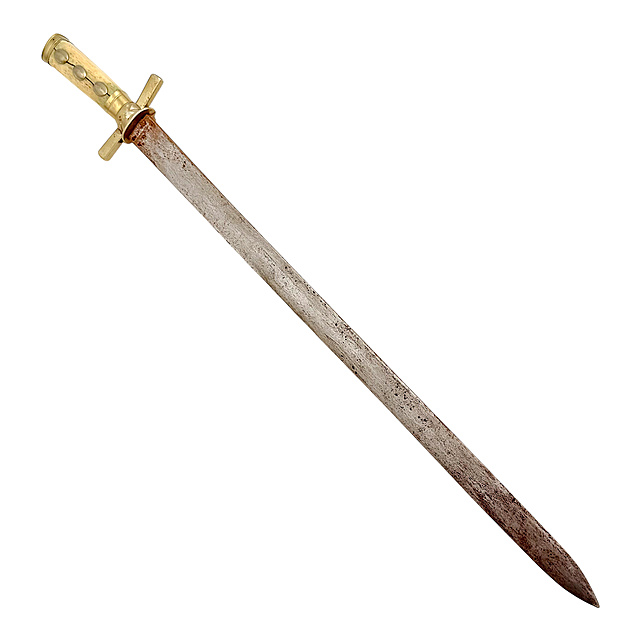
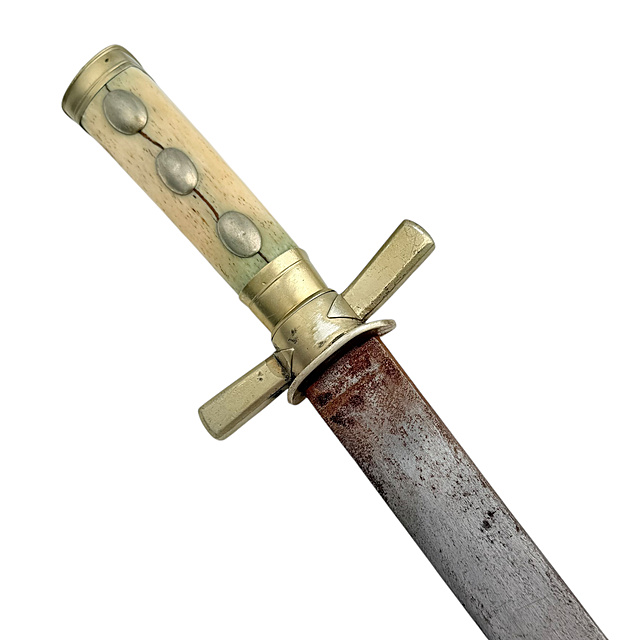
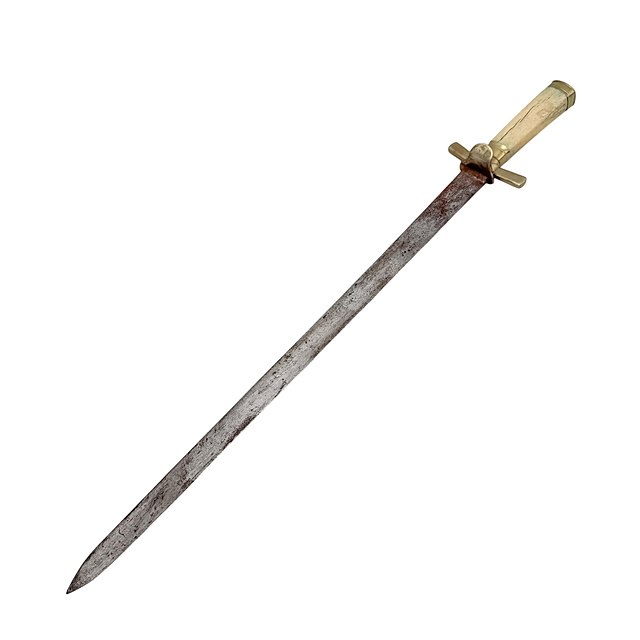
Military hunting hanger, bone grip, rivet rosettes, brass cross hilt, back-edged blade, 19th century
Bone, brass, white metal, steel. Military hunting hanger with light-coloured bone grip with three oval rivet rosettes of white metal, grip ferrule and pommel cap of brass. Brass cross hilt with straight, square-section quillon and small round shell guard at the blade root. Slender, straight back-edged blade, double-edged towards the point, on the blade rusted, barely legible stamps, probably “P”, “H” and “Z”. Without scabbard. Hilt and blade probably not belonging together. Bone grip with filled crack along the rivet rosettes, blade stained, hilt bright. L. 69 cm, blade length 54.5 cm.
Hunting hangers were the side arm of huntsmen and foresters, and with the Jäger troops the hunting weapon entered the military: the first Jäger were raised in Hesse-Kassel in 1631 from professional huntsmen and foresters, and Prussia made them a permanent part of the army in 1744 with the Korps der Jäger zu Fuß. Unlike the line infantry, the Jäger, armed with the rifled Büchse, carried a hunting hanger as side arm that was not fixed to the rifle. In the 19th century the Jäger and rifle battalions of the German states carried military hunting hangers as regulation weapons, which received acceptance and unit stamps and were supplied by Solingen firms such as Alexander Coppel, among others; the hunting hanger belonging to the Prussian needle-gun Jäger rifle M/65 could be fixed as a bayonet and after 1866 was also introduced in the Saxon Jäger battalions. Two basic forms of hunting hanger developed, the German version with knuckle guard and the somewhat shorter French version without guard.


Lot
Limit:
Your maximum bid: €
by telephone
When bidding by telephone, you will automatically bid the limit or the registered pre-bid (telephone bidding is only possible from €100). Only when the limit/pre-bid has been reached we will call you to bid further on. Your telephone bid will be treated as a written bid up to the registered pre-bid and will of course only be used to the extent necessary.
If you save your absentee bids on the bid list, you will be able to change or delete them until you submit them. If you do not submit your absentee bids, they will not be considered. They must be submitted before the auction starts.
You can submit your absentee bids now using the "Submit absentee bids directly" button, or later using the "List of Bids" menu item.


