
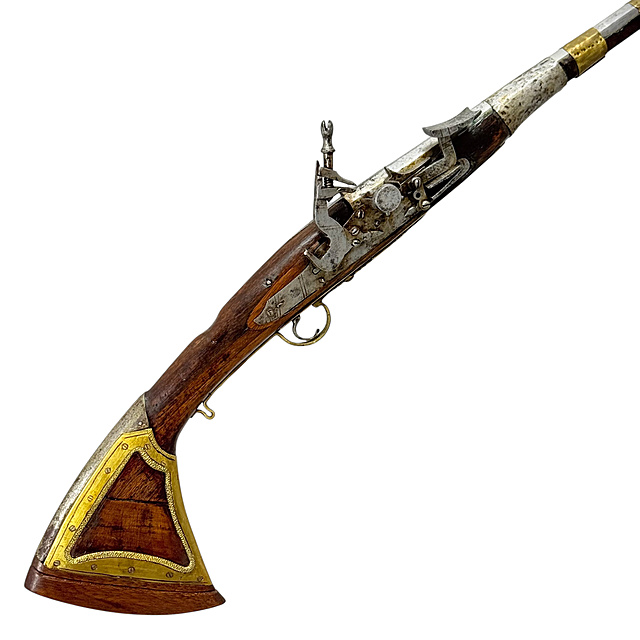
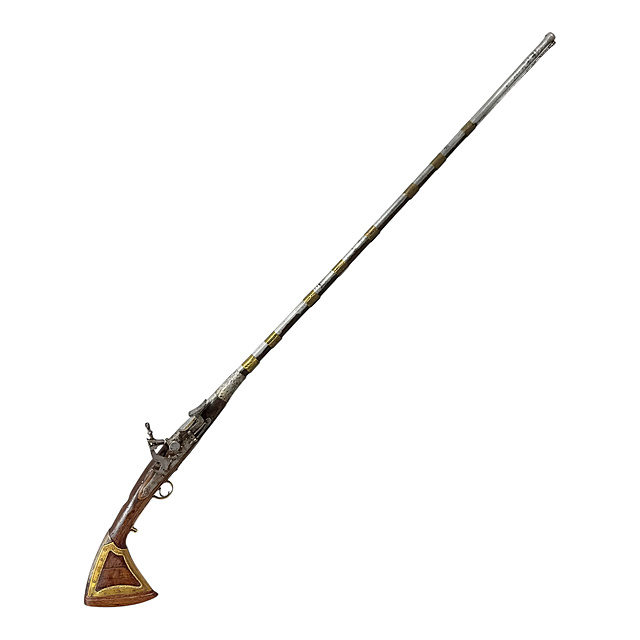
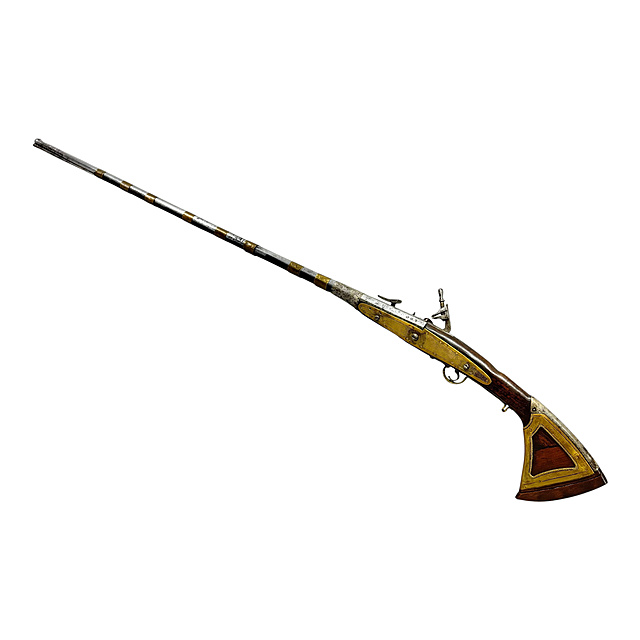
Berber Moukahla, North Africa, snaphance lock, brass bands and butt plates, probably 19th century
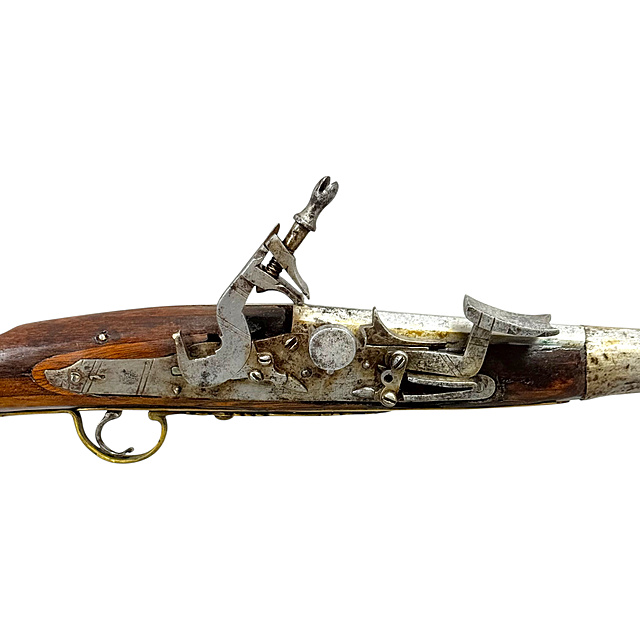
Iron, wood and brass, Berber gun Moukahla, flintlock gun with snaphance lock, North Africa, probably 19th century, calibre 14 mm. Very long barrel, breech with silver-coloured overlaid mount, fore-end with many brass bands, sling swivel. Snaphance lock with cock with flint jaws, frizzen on a separate arm with external frizzen spring, separate pan cover and iron lock plate with incised decoration, brass-coloured trigger guard, on the opposite side a large brass side plate along the entire length of the lock. Triangularly flared butt, overlaid on both sides with screwed brass-framed plates, silver-coloured mount on the back of the butt. Age-appropriate condition, barrel and lock pitted with rust, a crack in the stock behind the barrel, mechanism not functional, the trigger does not release. L. 162 cm
The Moukahla is the musket of North Africa, built by many tribes in Morocco, Algeria and Tunisia from the 17th to the early 20th century, and was the principal weapon of the armies of the Maghreb. Its ignition is either a snaphance lock after the Dutch-English model or a miquelet lock. The snaphance lock originated in the 1550s; its characteristic feature is the frizzen on a separate arm, separate from the pan cover. In Europe it was superseded around 1680 by the French flintlock, while in North Africa and the Middle East it remained in use. The barrel bands of these muskets are made of iron, brass or silver.


Lot
Limit:
Your maximum bid: €
by telephone
When bidding by telephone, you will automatically bid the limit or the registered pre-bid (telephone bidding is only possible from €100). Only when the limit/pre-bid has been reached we will call you to bid further on. Your telephone bid will be treated as a written bid up to the registered pre-bid and will of course only be used to the extent necessary.
If you save your absentee bids on the bid list, you will be able to change or delete them until you submit them. If you do not submit your absentee bids, they will not be considered. They must be submitted before the auction starts.
You can submit your absentee bids now using the "Submit absentee bids directly" button, or later using the "List of Bids" menu item.


