
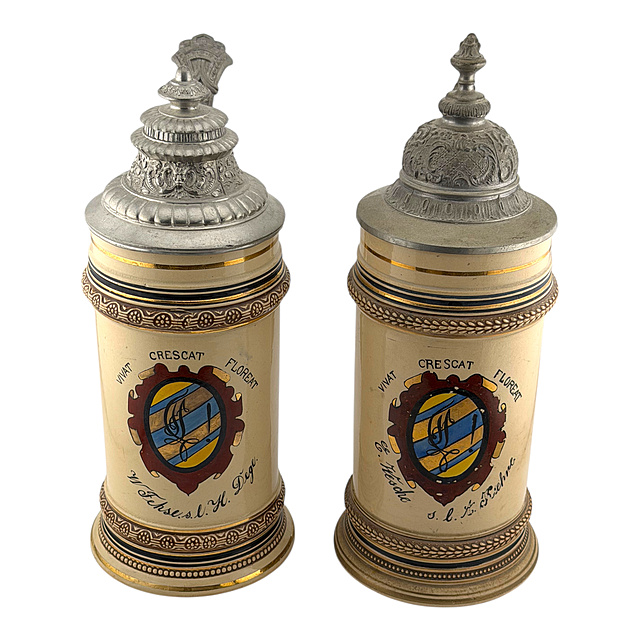
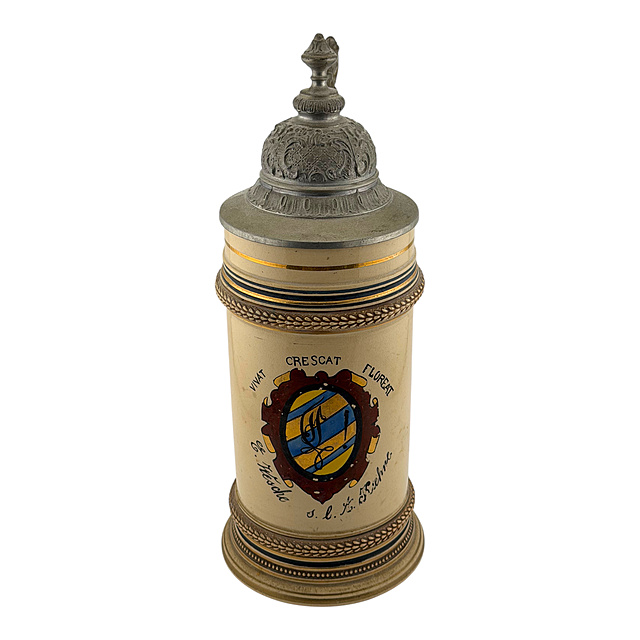
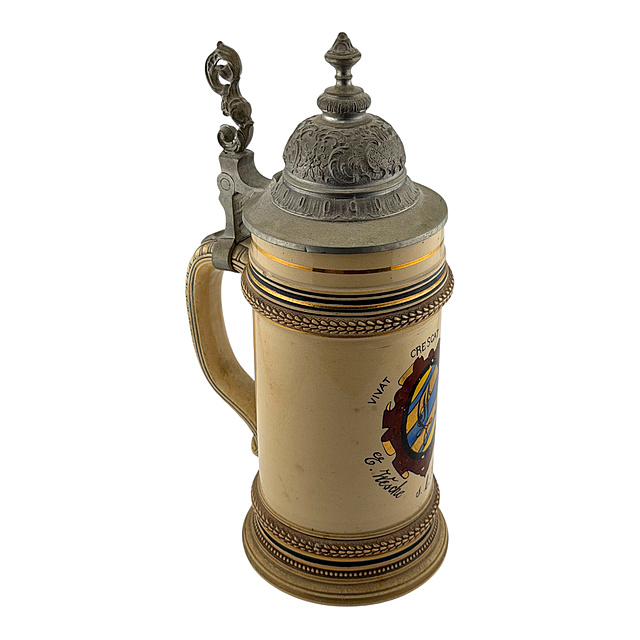
Pair of Steins from a Presumed Braunschweig Student Association, c. 1900
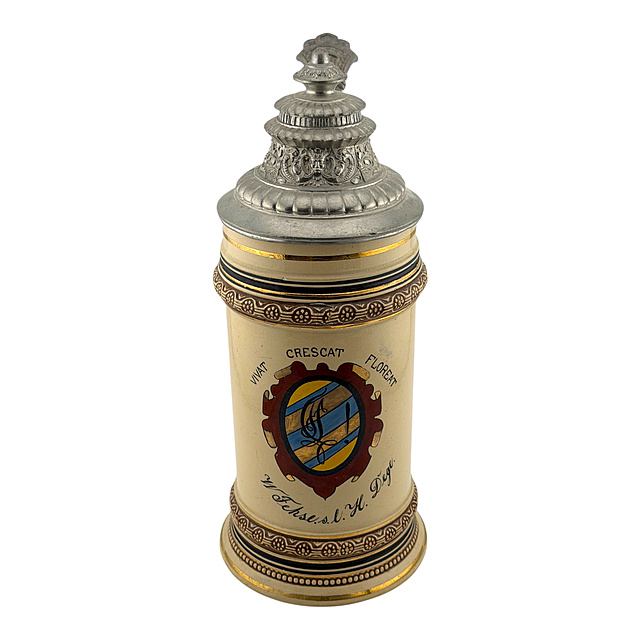
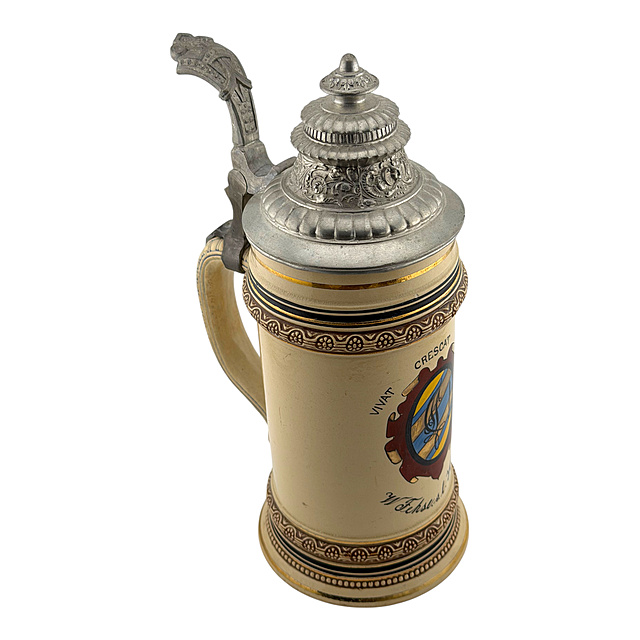
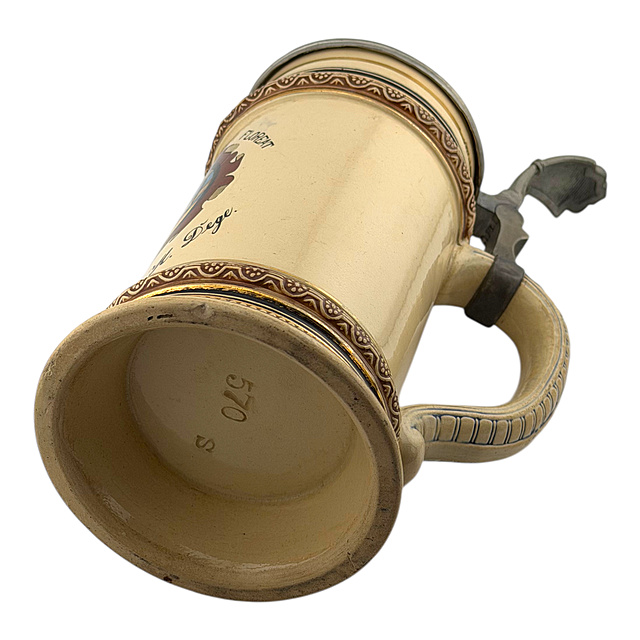
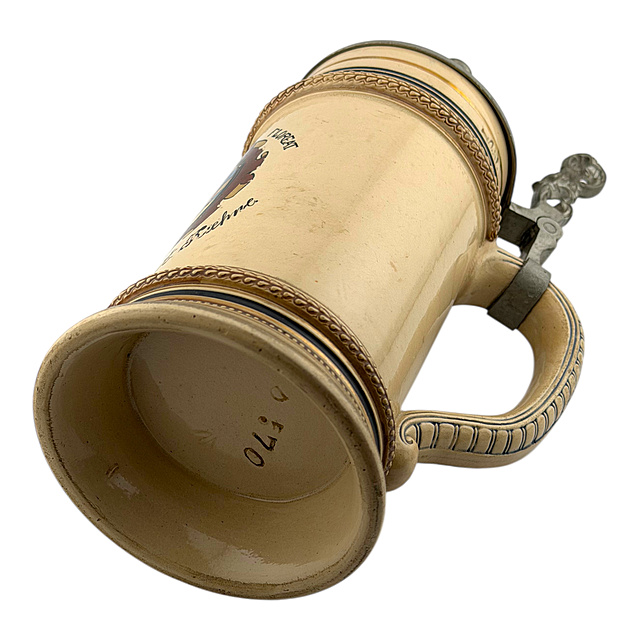
Two identically shaped, tall slender beer steins in ivory-coloured fine stoneware with relief-moulded decorative bands and substantial pewter lids (Westerwald, model no. 570). The front of each stein displays a hand-painted polychrome coat of arms. The central motif is the colour ribbon (Couleur) in the sequence gold-blue-gold with blue percussion (thin blue border lines flanking broad gold stripes and a broad blue central band). The colour scheme corresponds to the territorial colours of the Duchy of Braunschweig (blue-yellow), although student associations did not necessarily adopt local colours. The coat of arms also incorporates the cipher (Zirkel) of the association, which remains unresolved. The unusually high number of diagonal bars in the coat of arms is a feature not documented in any known student association. The coat of arms is framed by a red cartouche. Above it appears the Latin motto "Vivat, crescat, floreat" (May it live, grow, flourish). Below the coats of arms are personal dedications in black calligraphy: 1. "W. Fehse s. l. (seinem lieben / to his dear) H. Dege." 2. "E. Wesche s. l. (seinem lieben / to his dear) A. Kiehne." The steins have elaborately decorated pewter lids with relief ornament (scrollwork/mascarons) and tower-shaped finials. The thumbrests are sculpted ornaments. Each base bears the impressed model number "570". Both in good used condition. 24.5 x 10.5 cm (H x D).
Based on the colour scheme (blue-gold), the regionally typical surnames (Fehse, Wesche, Kiehne, Dege) and the provenance of the objects from the Braunschweig area, the steins point to a secondary-school or alumni fraternity (Pennälerverbindung) in the Braunschweig/Wolfenbüttel region. Such associations imitated the customs of university fraternities (hence the cipher and the coat of arms) and used the classic Latin toast "Vivat, crescat, floreat". The cipher remains unresolved. The steins are typical products of the Westerwald stoneware industry, which around 1900 individually painted steins with coats of arms and dedications for student associations.


Lot
Limit:
Your maximum bid: €
by telephone
When bidding by telephone, you will automatically bid the limit or the registered pre-bid (telephone bidding is only possible from €100). Only when the limit/pre-bid has been reached we will call you to bid further on. Your telephone bid will be treated as a written bid up to the registered pre-bid and will of course only be used to the extent necessary.
If you save your absentee bids on the bid list, you will be able to change or delete them until you submit them. If you do not submit your absentee bids, they will not be considered. They must be submitted before the auction starts.
You can submit your absentee bids now using the "Submit absentee bids directly" button, or later using the "List of Bids" menu item.


