
Student Beer Stein of the Fraternity Hansea Berlin, with Dedication, dated 1919
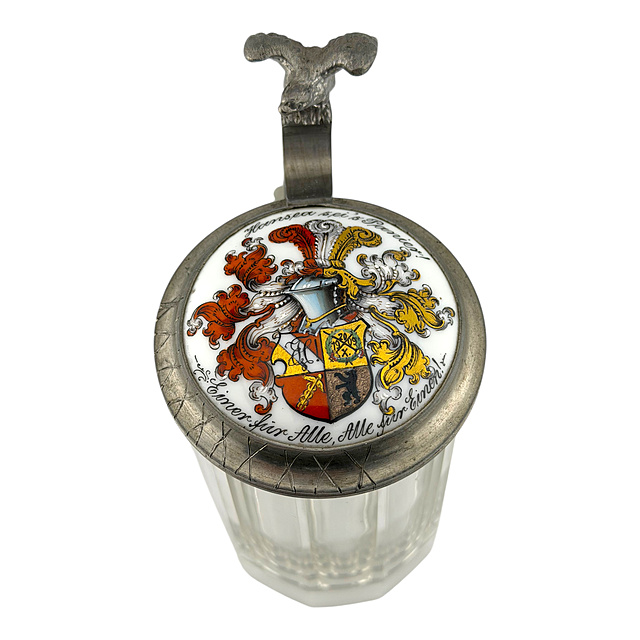
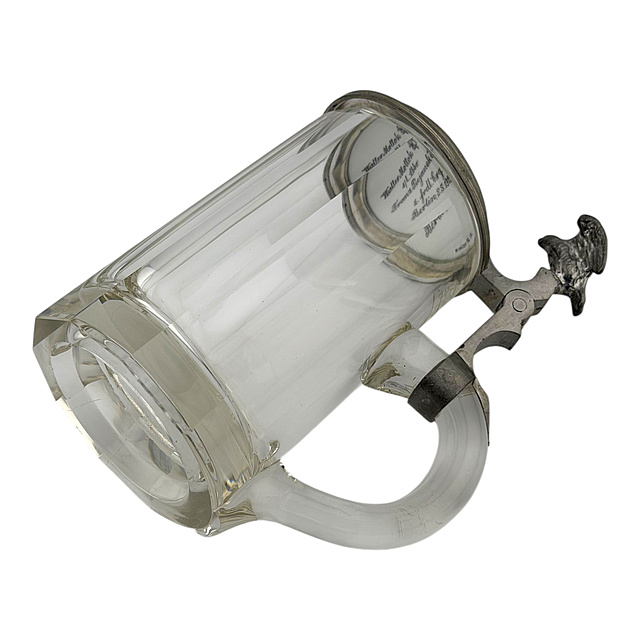
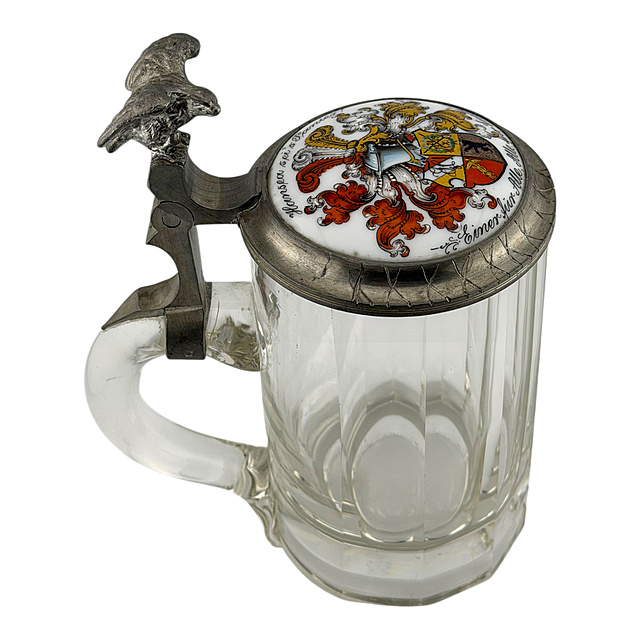
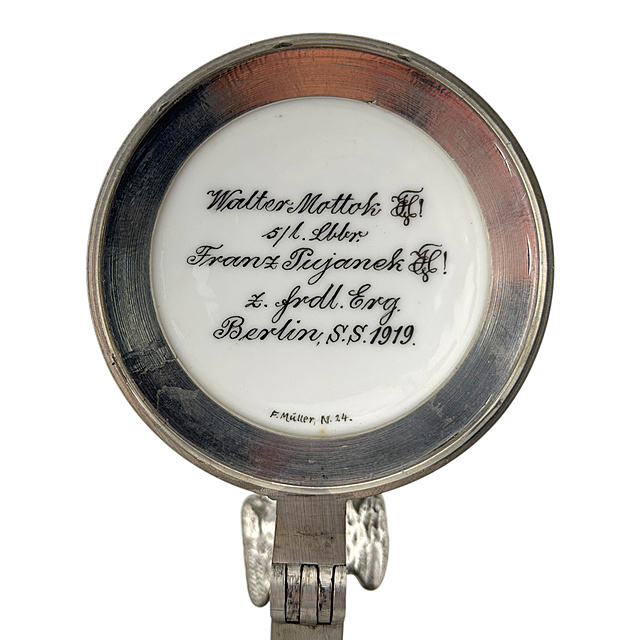
Classic student faceted stein made of colorless glass with pewter mounting and finely painted porcelain lid insert. The central motif of the lid displays the polychrome full coat of arms of the Fraternity Hansea Berlin. The quartered shield presents in the upper right field the founding date "20. X. 1909" above two crossed basket-hilt swords within a laurel wreath, in the lower left field a golden Caduceus (staff of Hermes) on a red ground as a symbol of trade and commerce, and in the lower right field the Berlin Bear on a golden ground. The first field displays the fraternity's Zirkel on a divided ground. Above the shield thrones a jousting helmet with red-silver and gold-silver mantling, crowned by a tri-colored crest of ostrich feathers in the colors Red-White-Gold. The coat of arms is framed by the mottoes "Hansea sei’s Panier!" in the upper round and "Einer für Alle, Alle für Einen!" (One for All, All for One) in the lower round. A plastically crafted eagle serves as the thumb lift. The surrounding pewter rim of the lid is marked with numerous manually carved cross-shaped notches ("X"). Inside the lid is the calligraphic dedication: "Walter Mottok Z! s/l. Lbbr. (to his dear Leibbursche) Franz Tujanek Z! z. frdl. Erg. (in friendly memory) Berlin, S.S. 1919". At the lower edge, the painting is signed "F. Müller, N. 24.". The glass body is multi-faceted and bears a calibration mark "0.35 l" on the upper rim. Good condition commensurate with age, 17.5x7.5 cm (HxD).
The Fraternity Hansea Berlin carried the colors Red-White-Gold. The founding date of October 20, 1909, and the Caduceus in the coat of arms indicate a fraternity with an economics background, presumably at the Commercial College of Berlin (Handelshochschule Berlin). The crosses carved into the pewter rim are authentic testimonies to student customs, so-called "Bierstriche" (beer strokes) or "Kannenstriche". It was customary to permanently document the consumption of whole measures (pitchers) or special achievements at Kneipen and Kommersen by carving into the soft pewter. These individual traces of use lend the object a special historical charm.


Lot
Limit:
Your maximum bid: €
by telephone
When bidding by telephone, you will automatically bid the limit or the registered pre-bid (telephone bidding is only possible from €100). Only when the limit/pre-bid has been reached we will call you to bid further on. Your telephone bid will be treated as a written bid up to the registered pre-bid and will of course only be used to the extent necessary.
If you save your absentee bids on the bid list, you will be able to change or delete them until you submit them. If you do not submit your absentee bids, they will not be considered. They must be submitted before the auction starts.
You can submit your absentee bids now using the "Submit absentee bids directly" button, or later using the "List of Bids" menu item.


